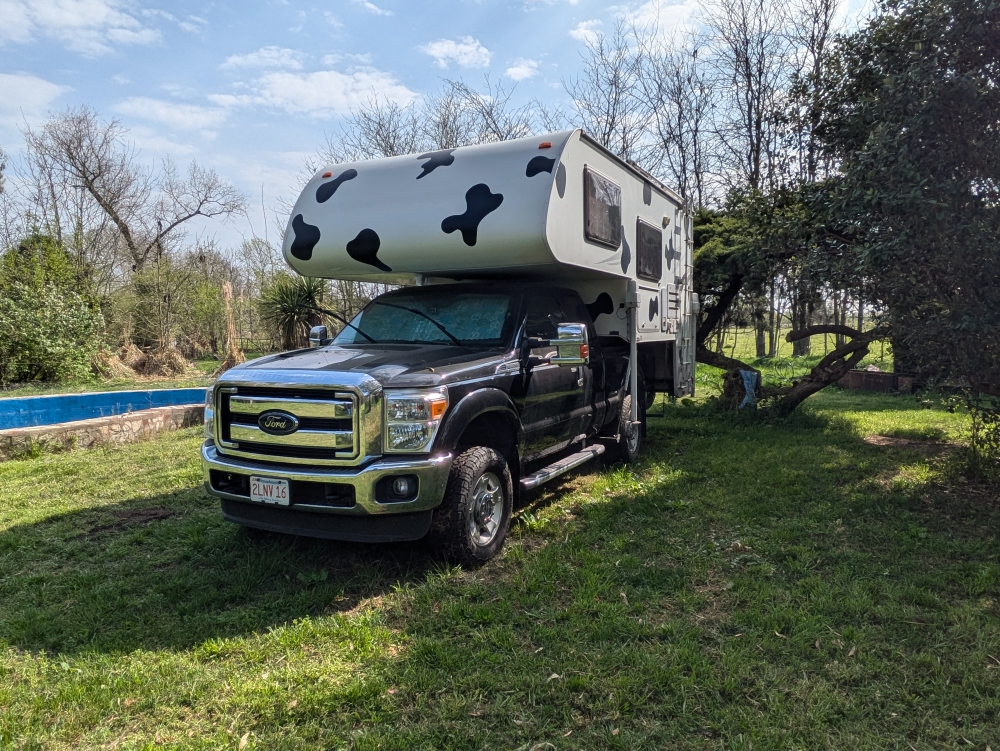
Happy New Year, everyone! Mark, Maya, and I wish you all a healthy, productive, inquisitive, comfortable, and adventurous 2025. Thank you for following Roaming About and appreciating that crazy lifestyle of ours.
I finally finished my Patagonia wildlife post, which contains lots of photos and videos. This footage hopefully gives you a better representation of our incredible encounters. Enjoy!
Route South to Ushuaia
Northern Part Route
Southern Part Route
After “killing” a month of time in and around Uruguay in anticipation of less cold weather in the south, Mark and I deemed November 1st a good time to cross the border into Argentina again and head to Patagonia along the Atlantic Coast. It was still spring in the Southern Hemisphere, but the goal was to reach Ushuaia, the bottom of the continent, by December 21st, the start of the austral summer.
(As always, hover over or click on the photos in the galleries to read their captions.)
Group of youngsters partying behind our camper, playing loud music and driving their motorcycles on the sidewalk.
Almost at our next destination to finally go to sleep!
We had a rough start of this 2,500-mile (3,750km) southbound journey in Gualeguaychú with lack of sleep due to a motorcycle event with revving engines until 2am and youth partying behind our camper at 4am. We packed up and moved in the dark to settle at a fuel station by 5:15am.
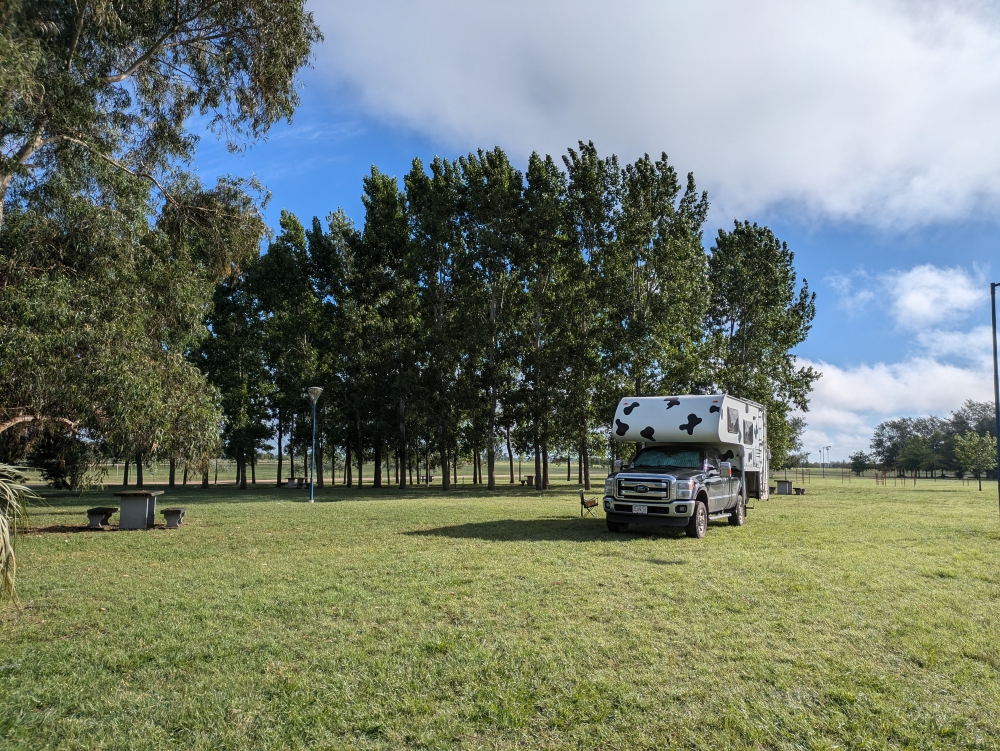
This park was quiet!
This was followed by hours of driving and eventually settling in a nice and free municipal campground for a few days to work. After that commitment, the three of us started to cover miles along a boring Ruta 3, stopping at a few points of interest and stocking up on groceries before reaching a more remote and expensive Patagonia.
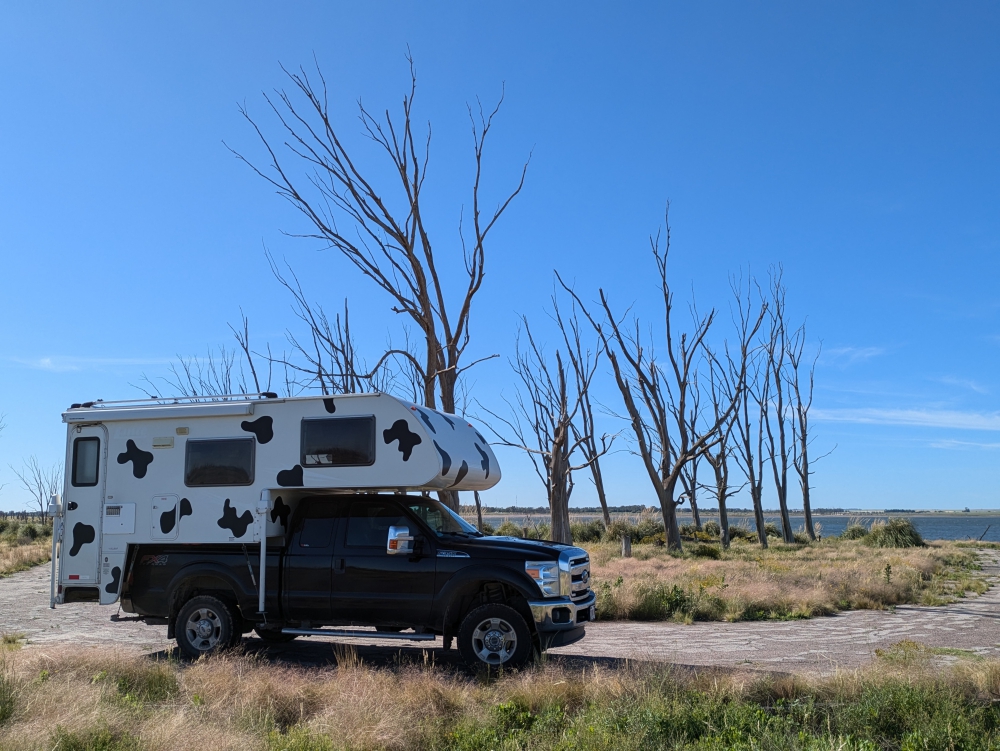
Eerie camp spot
One of the interesting sites we picked for a visit was Laguna de Epecuén, which draws tourists because of its eerie appearance. On November 6th, 1985 (exactly 39 years prior to our visit), an unusual weather pattern destroyed the dam and dike protecting the village of Villa Epecuén, flooding the area. This resort destination was never rebuilt and became a ghost town. Skeletal trees stand guard day and night, enhancing the barren scenario.
Signs in Spanish and English offer information and sketches of what was before.
A glimpse into the past
Remaining bars
Stairs to nowhere
Old playground
Rumble and ruins
Most overlanders drive to Ushuaia via the Andes Mountains that straddle the Argentinian-Chilean border, which is a more scenic route than our choice near and along the Atlantic Coast. There are three reasons we picked this “faster” and “boring” side of the continent: we were already located in the east when starting the last stretch of our journey south, we hoped to spend most of the summer in the Andes on our drive back north, and this route offered wildlife encounters.
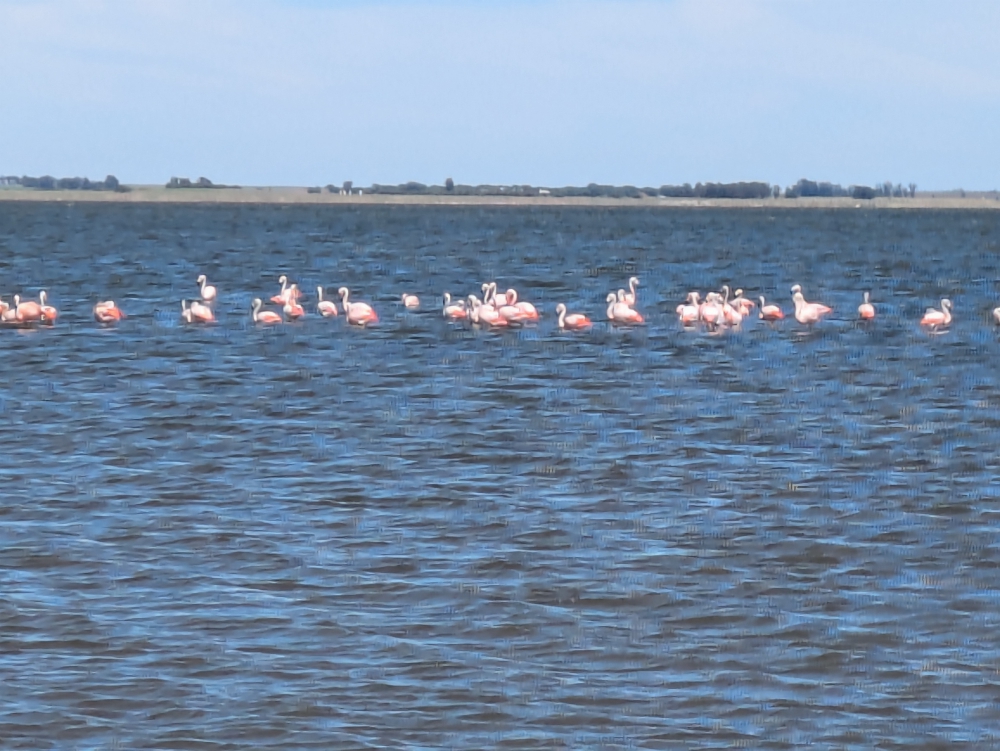
Flamingos on Epecuén Lake
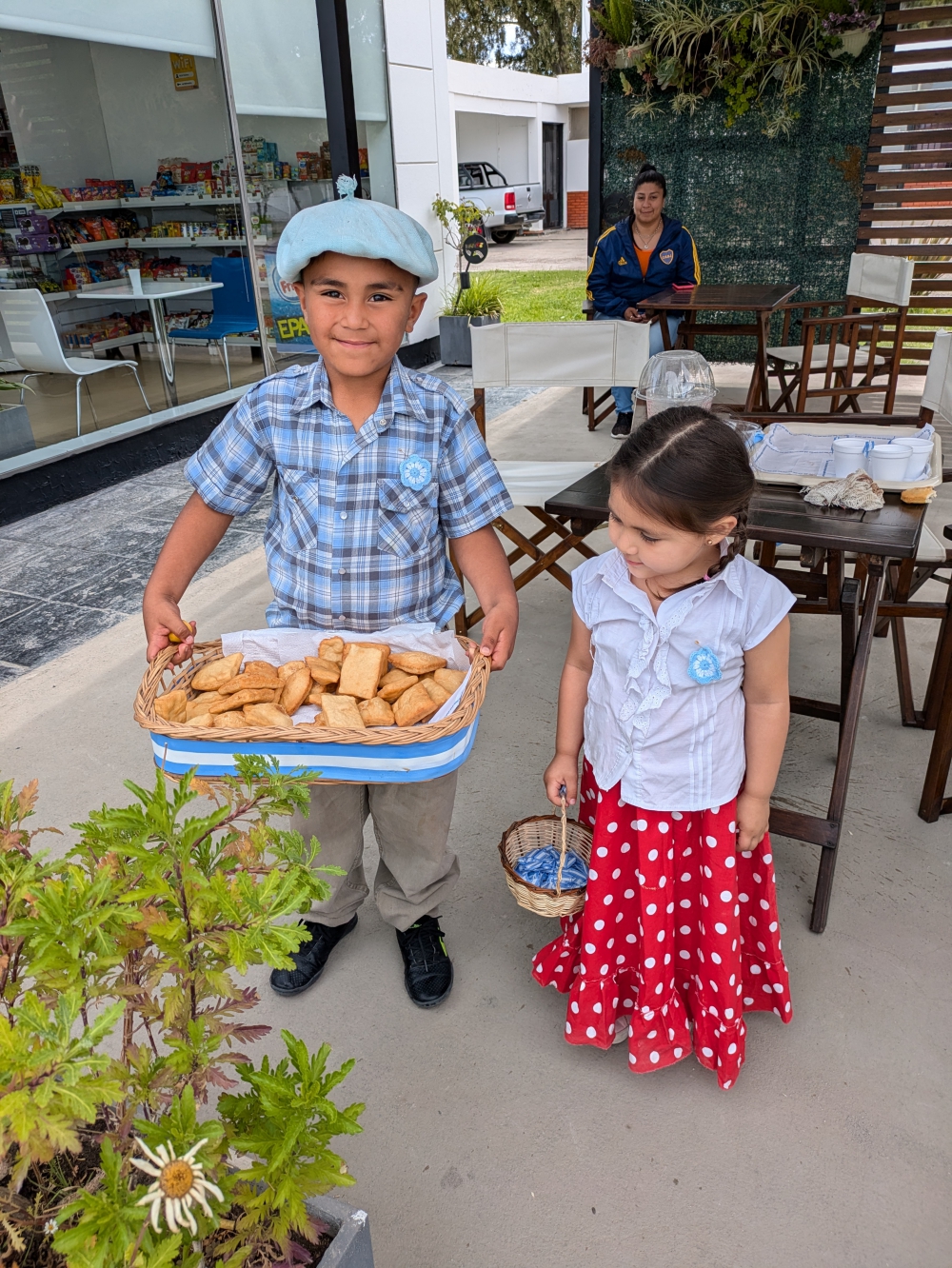
Besides the random flamingoes, no interesting animals had crossed our path yet. That was about to change in Balneario El Condor, located at the northern edge of Patagonia. This, we learned after going through multiple agriculture checkpoints. We arrived in the province of Rio Negro on El Dia de la Tradicion (November 10th) and were greeted by cute children offering goodies and cheaper fuel!
Local treats for Dia de la Tradicion
El Condor might be located off the beaten track, but we really recommend a stop here if you have your own vehicle. This is where the biggest colony of burrowing parrots in the world is situated.
Homecoming
Flying parrots
The beach in El Condor
Miles of cliffs are inhabited by these pretty, squawking birds that are a delight to witness. Yes, they are loud! Luckily, they go to sleep at night, but the nights at this time of the year are short. They made sure we went to bed with them and woke up with the first sunrays!
Warning: This is a long post, heavy on photographs.
Mark, Maya, and I entered Uruguay from Argentina without expectations. We knew the coast drew lots of people, Montevideo was the capital, and Colonia del Sacramento was a highlight and UNESCO World Heritage Site. And that the country was super expensive, aptly called the Switzerland of South America.
(As always, hover over or click on photos in galleries to read their captions.)
Uruguay in South America
The country of Uruguay and our sights
Uruguayan flag
Uruguayan license plate
Dealing with the border formalities was a bit confusing (everyone from either side wanted to inspect our camper) but didn’t take too long. We were a tad nervous regarding the “prohibited items” we brought to sustain ourselves and our dog (check the blue sign and guess what we carried), but Maya’s paperwork was in order, which proved important – and distracting – enough.
Walking to the border offices to deal with all the paperwork
Ready for a new country in Thirsty Bella
How many of these items did we have in our camper?
Salto Grande Dam
Right across the border, on the outskirts of Salto, we stopped by the Salto Grande dam, operated by both countries. There, Mark and I partook in a free tour, conducted in Spanish.
The massive turbines
Viewpoint over the dam
Salto Grande Dam, seen from Argentina
One of the massive doors that regulate the water flow
Driving back from Argentina to Uruguay on the tour bus – we did this two hours earlier in our camper; the dam is the border crossing in Salto.
Afterwards, mid-afternoon, we decided to put some miles behind our wheels, since we hoped to cross the entire country and reach the coast within a few days. In Uruguay, we planned our route and stops more carefully, due to the costs. When gasoline has a price tag of $7 a gallon (about $2 per liter), you think twice about detours and their “worth.”
Our first camping spot for the night was a bit overgrown, but hidden from the road!
Our second night was spent in a free campground that was flooded.
Our third free camping spot necessitated driving under this low bridge; we just fit!
The end of this turnaround point was the only spot with open sky and sunshine, needed for Starlink, solar power, and an anxious dog.
We stopped at a small clearing in the bushes, out of view, for that first night. The next three days, we leisurely traversed the hinterland of Uruguay, gazing at the well-kept homes and fields and feeling happy for the livestock – mostly horses, cows, and sheep – with all that juicy, bright-green grass everywhere!
Happy cows in Uruguay
Lush and pretty fields
We also came across a dinosaur display, with preserved footprints and information signs.
Signs with info in Spanish
Dinosaur track on display
Old footprints!
The people we met along the way were friendly, we enjoyed this peek into lesser-known territory, and we happily noticed the lack of garbage everywhere, but we were surprised at the state of the throughways.
Filled potholes; one can wonder if it’s better or worse to hit these piles of fresh asphalt.
One of the gravel roads
Maya doesn’t like dirt roads and holds on for dear life.
Broken road surfaces
We would not fit on this bridge with our camper.
Old car from a local driver
Thinking that Uruguay was a relatively developed nation with a relatively western mentality, we had counted on beautifully paved main roads everywhere. Not in the back country. For at least 100 of the 400 miles across, we dealt with broken pavement, potholes, road work, or dirt tracks going east-west. The north-south equivalents seemed in better shape.
La Coronilla
The Atlantic coast brought pleasant surprises. First, we arrived at La Coronilla at the exact same time a familiar-looking kombi VW bus did. Mark recognized them as the Kombi Chronicles, a British couple with two cats, who had been exploring Latin America overland for a few years. We knew Willow and Lee through Facebook, WhatsApp groups, and mutual friends. It was great to finally meet! (They have a popular YouTube channel and Facebook page as well.)
Meeting Willow and Lee of the Kombi Chronicles for the first time
The VW bus of our Kombi Chronicles friends, parked on the bluff
Sunday afternoon with our new friends
After an introductory chat, they decided to stay another day, a Sunday, on which we hung out all afternoon and evening, chatting, exchanging stories, and sharing popcorn and wine. It’s always nice to meet like-minded folks and we hope to run into them again soon, on the way to – or in – Patagonia.
Our camping spot in La Coronilla; away from the parking area
Maya is much happier on the bed than in the car, these days.
Our boondocking spot offered an “exotic” setting under palm trees, long walks on the beach, a decent view, and the sound of waves when falling asleep. It was quiet at night, so all three of us could rest up.
First beach walk with Maya in a long time!
One of many dead penguins along the Atlantic beaches
After a three-month “summer break” in Massachusetts and Belgium, Mark and I looked forward to returning to our RV life in South America, which promised new adventures and horizons. But first, we had a few hurdles to overcome.
Route North in Argentina
Camp spots along Salto Grande Reservoir
For the first time since finishing our sailing episode in Tahiti in 2015, we decided to check a bag (we usually only fly with three or four carry-on/personal items). We needed to bring back spare parts and gear to fix our camper and truck, plus a few liquid novelties like maple syrup and dog shampoo. It had taken multiple attempts to fill this bag and not exceed 50 pounds. It was tricky, as we also didn’t want things to shift in this enormous duffel. Padding added weight. I even tried to put all our “to check” luggage into our carry-on roller, super tight, too tight, with a ripped zipper as a result.
In the end, I succeeded with the duffel bag. Since we had plenty to carry with us on the plane, I stuffed our rain jackets inside it as well. The scale at the airport showed 52 pounds. Ouch. But the lady was super friendly and impressed relieved that we only had one checked bag, so she let the overweight go. Thanks!
Then, we flew from Boston, MA, to Buenos Aires, Argentina, via Miami. We arrived early and hadn’t slept for 24 hours. The day had only just started and it was September 21st, the arrival of spring in the Southern Hemisphere.
We dealt with immigration (long lines), nervously waited for our one bag to arrive as one of the last pieces on the belt (that’s why we hate checking bags), swung by the friendly guy at agriculture for Maya’s paperwork, and sent all our luggage through X-ray machines at customs. And all that time, Maya couldn’t relieve herself, which stressed us out.
Our sets of metal brake pads raised questions. We managed to talk ourselves out of the legal fact that no traveler is allowed to import car parts. Not even when your Ford F350 doesn’t exist in Argentina and neither do the parts!
The exchange rate from dollars to pesos was horrible at the airport, so we passed on that, planning to pay our storage fee in USD. Finding an Uber that accepted dogs proved to be difficult as well. We lined up three taxi drivers, only to have the last man not cancel after we sent a private message about our well-behaved Maya. He took a few wrong turns and forgot to switch the meter off when he delivered us, but we made it to our home on wheels by 10am!
Reunited with Thirsty Bella on Julian’s property
Julian’s property had been perfect and affordable to store Thirsty Bella, but we knew from dropping our camper off and needing to prep it to be left unattended that this is NOT a usable campground, without running water to fill our tank or hot water in the shower block and with barking dogs and their poop everywhere. The mosquitoes were less of a problem, but now the toilet bowl had a gaping hole in it; flushing it flooded the bathroom floor and not in a pretty way. Don’t ask me how I know…
Anyway, after our set-up was rudimentary ready, we needed to leave ASAP. Plus, we had no food or drinks at all, after emptying the cupboards and fridge before we left. The first task at hand was start the truck. With a totally drained battery, this took a while, with the help of Julian’s trickle charger. Next step: reinstate our Starlink satellite internet account, which we had paused for three months, saving $210. Mark relocated our sign-up address from Peru to Argentina to avoid issues in the future.
Around noon, we generously rewarded Julian and his wife, Sofia, for their hospitality and help, before hugging them goodbye and maneuvering our camper under low-hanging electrical cables (which needed lifting with a stick) and through the narrow gate.
(As always, click on or hover over photos in galleries to read their captions.)
Leaving the challenging property where we’d stored our camper
Julian and Sofia
We stopped by a small tienda in a city with tight streets (Mark wasn’t thrilled about this unexpected “big rig” driving test on day one) to stock up on some staples and made our way to Zapparancho, the campground ran by the well-known Zapp family, who traveled around the world in an old, classic car for over twenty years. Our trio had stayed here in the past, so we knew Herman offered the right facilities to get ready for the road.
Welcomed back by Herman at his Zapparancho
The travel car of the Zapp family
Zapparancho – where (Argentinian) dreams begin….
A map of their route
The resident horse that thinks it’s a dog
We immediately filled up with drinking water, discovered an issue with the water heater – after three plumbing attempts, this got fixed – and realized our bathroom tap, which acts as a sink faucet as well as a showerhead, was leaking profusely and needed to be replaced. Darn. How can things break while they’re not being used?
Filling the camper with potable water again
This wall painting was new since our last time here
Testing and comparing two old tablets to act as our battery monitor
Mark fixing the water heater
Installing a new rod for the door, so it finally stays open again
Maya keeps busy with a new bone from the US
Luckily, our American motorcycle friends, Brandon and Katherine, were returning to Buenos Aires in a week as well. They happily received the package and brought the small part to our next meeting point, about ten days later.
The faucet that broke
New faucet in the bathroom. Thank you, Brandon and Katherine!
Zapparancho is a popular and buzzing place, where travelers meet and share meals. Yet, the price added up each day, standing water attracted mosquitoes, and the nights were noisy. We wanted to keep focusing on the jobs at hand and looked forward to getting on the road again.
Music and social times at Zapparancho
Shared pizza dinner at 11pm…
The sun was bright, but the wind was strong as we prepped our camper, went grocery shopping, did laundry, and organized everything the way it was.
The attractive cathedral of Lujan
Shopping in Lujan – store one
Shopping in Lujan – store two
Doing laundry; the last errand before leaving Zapparancho
We postponed the “big engine project” until later in the week. For that, we moved closer to the building. It blocked the wind, so no dirt would enter the engine compartment and work would be easier.
Moved to the building at Zapparancho, to be protected from the wind
Our afternoon here turned into an extra day and night
Which work? Mark needed to replace the 16 sparkplugs and 8 ignition coils on the engine block, all in one go. I was his assistant and mental support person, as always. It didn’t take long before I heard him curse. One of the sparkplugs was stuck. It didn’t want to unscrew. As he predicted, this turned into a massive ordeal! When he finally got it loose, the threads were damaged, meaning the receiving end on the engine block was compromised as well and the new sparkplug couldn’t go in.
Mark has organized all his tools and the new parts
Keeping track of old and new parts
I will make a long story short. We finished replacing the other 15 sparkplugs and all the ignition coils without issues and then focused on the damaged sparkplug, which had been inserted incorrectly by the factory. Our car only has 60,000 miles on the odometer and this was the first time the sparkplugs were touched by a person. Yes, this miss-threaded part was Ford’s fault; a rare mistake.
Yet, here we were. In Argentina. Without the right equipment, confidence, or knowledge for an issue of this magnitude. And far away from a good mechanic in the capital. One piece of metal accidentally entering the motor block during any maneuver and our engine would be damaged and possibly needing replacement! Mark fabricated a rethreading/chasing tool out of an old sparkplug to “clean” the threads but, ultimately, we didn’t trust ourselves to do the job.
The damaged sparkplug
Making a “chaser” out of an old sparkplug
So, we researched and enabled the best mechanic we could find in Buenos Aires, convinced him to drive out an hour and half each way to help us, and hired him to do the work. His initial quote was $300-$400. But… the first time he and a helper arrived, they were baffled by the tricky nature of this job and preferred to return the next morning, Saturday, with proper tools.
First visit by the mechanics from Buenos Aires
Necessary hot water for mate, for the drive back to the capital
That morning became evening, but they eventually showed up at dusk with modified tools and an endoscopic camera and – after a couple of hours – they cautiously and professionally fixed the issue, inserted the new sparkplug, and listened to the engine purr nicely. The final price for the job was $600, which hurt, but was better than the feared-for, worst-case scenario! And, we could get back to our travels the following day.
Endoscopic camera to see what’s going on with the threads
Second visit of the mechanics – one of them has to lie on the engine of our big truck to reach things
Final assembly of the engine parts
Luckily, we were not in a hurry as early spring is still too soon to head south to Patagonia and Ushuaia. We had a month of “lingering around” planned, to wait for better weather. We left the capital area and headed north in Argentina. Our initial camping spot didn’t work out due to it being a Sunday, which means packed parking lots and parks. So, we ended up at a truck stop in Zarate. Nothing too glorious for our first night back on the road!
Our first night back on the road – a truck stop/fuel station
The coming and going of semi trucks made this place loud at night.
Our next destination was Gualeguachú, which takes a while to pronounce. We found a grassy spot along the river to park up for a few days, work, and explore town. We braved one super-hot and humid day on which we couldn’t do much.
Freshly painted sign!
Our grassy camp spot along the river of Gualeguaychu
Walk through the old harbor
Walk along the river
Nice building on our walk through town
Church in the center of town
Back to wads of cash – this is the equivalent of $100
Who would have guessed this heat in spring? Luckily, it was only one day.
We also needed a blood test and paperwork for Maya to enter Uruguay. On our walk to the vet, she got attacked again by a loose, owned dog. Not a stray. Stray dogs behave friendly or shy; not protective.
Vet visit to get Maya’s newest paperwork
Leishmaniasis blood test for Uruguay
Followed by loose dogs
We urgently had to come up with a rough, northern route. Initially, we wanted to make a loop through Southern Brazil, along the coast of Uruguay, and back into Argentina. After deliberation, and chats with my virtual travel friend and blog follower Gilda (who is from Southern Brazil), we changed plans and decided to skip that part of her country. This would save us a chunk of time and gas money.
It was in Gualeguachú that Brandon and Katherine joined us for a night with their motorcycles and tent. They brought their Argentinian friend, Federico, which produced deeper insights into the country and culture for us. We shared a nice dinner in Bella and enjoyed a fun evening and restful night.
The arrival of our friends and their friend
Hanging out and soaking up the sun with Katherine, Brandon, and Federico
We’d forgotten Maya’s precious bone at Zapparancho and Brandon found it when they camped there for the night! Happy us – and happy Maya!
Our setup along the river (Photo courtesy of Brandon Lever)
Happy hour with new and old friends (Photo courtesy of Brandon Lever)
Girl talk with Katherine (Photo courtesy of Brandon Lever)
Mark grills chicken on our BBQ (Photo courtesy of Brandon Lever)
Grilled dinner inside Bella with all of us. It was the first time we ate inside our camper with five adults!
The following day, after Mark and I ran more errands, our little group met up again, further north, at Punta Viracho. Federico had moved on towards Paraguay.
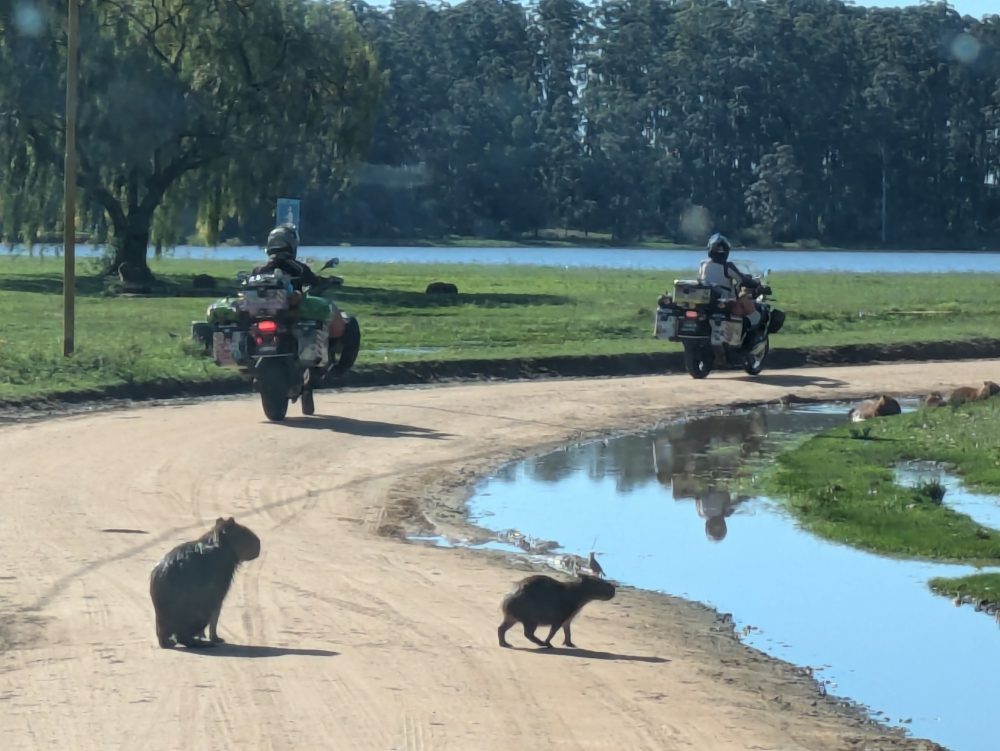
Passing through a herd of capybara on our way to the campground
Brandon and Katherine love hot springs and they’d discovered that staying at a campground in that area was affordable and included unlimited entrance into hot pools and a waterpark within walking distance. We took their invitation and camped close together for a few more nights. We could see Uruguay on the other side of the massive reservoir that is Salto Grande.
Settled next to the reservoir in an established campground.
Camped next to our friends at this campground
Our set-up at the campground for three days
Another dinner together
Our first highlight – and surprise – was the herd of capybaras that lives on this peninsula. It was amazing to just watch and photograph the adults and babies.
Posing with our new neighbors
Resting capybaras
Capybaras lined up near a puddle – they love water!
More capybaras
A walk among the capybaras
Family of capybaras
Nice coincidence!
Maya – on a leash – behaved really well among these wild creatures.
This group wasn’t very shy!
So cute!
Here is a video from when they walked by.
And, who knew they like to swim?
We weren’t the only ones happy to soak!
Swimming capybaras at dusk
We enjoyed quality time and homecooked meals with our friends and managed to soak and play in the hot pools several times as well. Since it was weekend, however, the pools got crowded.
Walk to the hot springs and past the capybaras on our first evening
Peacock at the pools
Big lizard at the pools
Soaking with friends
One of the peacocks in full glory
And, I really have to stop doing crazy things at my age. This was the fastest slide I’d ever been on!!
Hugging our dear friends goodbye was more emotional than usually, as we won’t see them again on this continent. We had the fortune of meeting up in five South American countries – Colombia, Ecuador, Peru, Bolivia, and Argentina – in the last year and a half, but now they’re hopping over to Africa to continue their world travels.
Katherine and Brandon ready to go, in the rain
Bye, bye, friends!
The three of us only hopped to the next peninsula (Soler) along the reservoir for a couple more days of rest, wind, and rain – and stress for Maya, thanks to twigs and leaves falling onto the roof of the camper – in Argentina.
Rainy camping spot on Peninsula Soler
Nervous Maya chewed through her leash when we tried to prevent her from joining us in bed after a third night of her panting and us not being able to sleep!
View of the reservoir
Wet forest walk
On a walk with our dog, we heard these weird noises…
Unfortunately, because of our location by a turnaround point at the end of the road, it proved much busier and louder than expected. So, on October 9th, after filling our gas tank and pantry, we left Argentina and entered a new-to-us country: Uruguay.
Heading towards the border with Uruguay
Stocking up in Concordia, Argentina, before crossing the border into Uruguay
Filling up with fuel – including our jerrycan – in Concordia, Argentina, before crossing the border into Uruguay
Time for a new country!
Next up: Our monthly expense report for October 2024
Curious about a previous ten-year chapter in our nomadic lives, which includes eight years aboard a 35-foot sailboat in the tropics with dogs, check out my compelling, inspiring, and refreshingly honest travel memoir:
Plunge – One Woman’s Pursuit of a Life Less Ordinary
After Mark and I made plans to go on a ten-day vacation with my cousin, Griet, and her husband, Wim, we needed to pick a place. The four of us briefly considered Eastern Poland plus part of the Czech Republic (too much driving) and Denmark (too expensive), destinations within the 900km radius we set as a maximum distance. Together we’d already been to northern France and the Netherlands during long weekends, so we settled on the Black Forest in Germany for one week and Liechtenstein for two days. Adding all the driving, we’d be gone for eleven days and ten nights.
Part of Europe, with tiny Liechtenstein
The country of Liechtenstein
Why Liechtenstein? It sounded mysterious, I’d never been there, neither had anyone I know, it can be visited in a short time, and it wasn’t too far away from the Black Forest.
Liechtenstein flag
Liechtenstein emblem
Because Liechtenstein is very expensive (as is Switzerland), we opted to stay nearby in Austria for three nights and use a roomy, well-equipped, but hot apartment in Koblach as a base. Not that we were home a lot! Most visitors peruse this tiny country in one day, but we managed to keep ourselves entertained for two full days; enough if you don’t plan any hikes in the Alps.
(As always, click on or hover over photos in galleries to read their captions.)
Entering Austria at an old border gate
One of the two balconies at our Airbnb
Dining room
Our bedroom – this was the only rental that had two bedrooms
Liechtenstein is a German-speaking, 25km-long principality (ruled by a prince) between Austria and Switzerland, officially called Principality of Liechtenstein ((Fürstentum Liechtenstein). Hence the letters FL on license plates.
Crossing the Rhine river between Switzerland and Liechtenstein
Liechtenstein license plate
The country is double-landlocked, which means that its neighboring countries are also landlocked. There are only two of those in the world: Liechtenstein and Uzbekistan. It has around 40,000 inhabitants and consists of just over 160 square kilometers (62 square miles). It is Europe’s fourth-smallest country and one of the few nations in the world without debt.
While Liechtenstein is not a part of the European Union, it has a close (financial) relationship with Switzerland, which explains the local currency being the Swiss franc. Credit cards are widely accepted. To save money, we brought sandwich lunches on those two days in the country.
Swiss scenery
Driving through Switzerland every day
Maya gets comfy on my feet in the back of the car
On day one, we skimmed along Switzerland’s eastern edge, crossed the border, and focused on the bottom half of Liechtenstein. We started at its southern tip, in Balzers, where we climbed a hill and visited the deserted Gutenberg Castle. The inside was not accessible but we still enjoyed the looks of this typical castle and its views over the mellow city.
First glimpse of Gutenberg Castle in Balzers
The Liechtenstein-weg is a trail that crosses the entire country.
Followers of this blog might have come across the names Griet and Wim in the past. My cousin and her husband are more than just family; they are friends and fellow travelers who have visited us on many occasions. Every year or two, they joined us on our sailing catamaran Irie in the tropics (once with their then teenage children), they stayed at a house sit in California, and, last fall, they traveled with us in Peru for three weeks. Whenever we are in Belgium, we spend a lot of time with them (two weekends this summer, involving beer brewing) and – when time permits – we go on trips together.
Since Mark, Maya, and I dedicated two full months in Belgium, we decided on a ten-day vacation in Germany and Liechtenstein with them. If you know us, traveling the world is our lifestyle; we combine chores, work, driving, visiting, and leisure. Vacation time – strangely enough – is rare. To be honest, this trip with Griet and Wim was my first real holiday in 21 years and Mark’s first week off, since he started his current job two years ago. So, it was a special occasion!
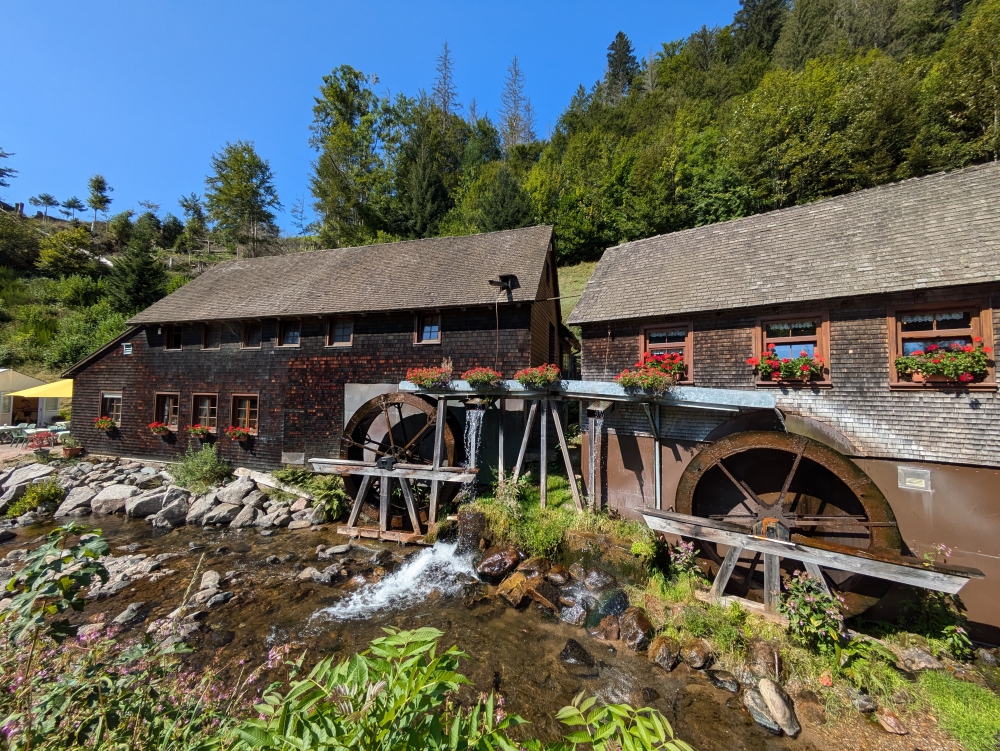
Hexenlochmühle in the Black Forest
Being from Belgium, it is hard to believe that I’d never set foot in the Black Forest! And, even my cousin and her husband had never vacationed in Germany before. Mainly because none of us speaks the language, although we did just fine and knew enough German to get by. Other than Mark. 😊
We broke up the 7-hour drive to the Black Forest with a walk and sandwich lunch stop at the popular and crowded Geierlay suspension bridge. It is the second-longest one in Germany.
(As always hover over or click on photos in galleries to read their captions.)
The Geierlay Suspension Bridge
Mark walks Maya across the gorge on this narrow bridge.
Gorge that holds the suspension bridge
Wim and Griet on the suspension bridge
Our group spent four nights in the northern part of the region, in an apartment in Enzklösterle, which was surrounded by woods. Ideal for walks with Maya.
Morning walk with Mark and Maya in the forest
Soaking up the early sunrays
Forest walk near our first Airbnb
The Airbnb was well equipped and we especially liked the outdoor space. The weather was good enough to have happy hours on the balcony. We cooked some meals at home, often packed sandwich lunches. and ate out every other day or so. This routine kept the trip affordable.
View from our balcony in Enzklosterle
Relaxing on our porch in Enzklosterle (Photo courtesy of Griet Collaert)
Mark cooks dinner in our first Airbnb
One of our dinners at home in Enzklosterle
On chilly nights, we ate dinner inside
From Enzklösterle, we made daytrips to the surrounding villages and natural sites. Our rough schedule during those ten days was to leave around 9:30am and return by 5pm; quite busy for Mark and me.
Many of you know that I, Liesbet, was born, raised, and educated in Belgium. But, did you know that it has been 21 years since I actually lived there (July 2003)?
Goodbye party invitation front
Goodbye party invitation back
That’s right, I have officially been a nomad for over two decades now. During that time of sailing, RVing, house and pet sitting, and overlanding (a fancy term for roughing it internationally in a vehicle), I tried to return to my home country once a year or every other year. During Covid, it took three years before I was able to see my family and friends again. Too long!
For me, it comes easy to leave everything behind, because I have an adventurous streak and do just fine on my own (and with my husband and furry companions). If I were to get homesick easily, miss my loved ones too much, or crave familiarity and routine, this roaming lifestyle would not be a good match! That is not to say I don’t enjoy summer visits “back home,” usually for two or three weeks at a time.
(As always, click on or hover over photos in galleries to read their captions.)
Ready to fly to Belgium
Departing Boston
On the plane – we were the only ones wearing a mask!
Mark, Maya, and I are currently in Belgium. For two entire months! This is beyond exciting and special. For once, there is no need to rush, have an overfull schedule, and feel more tired when I leave than when I arrived. It’s not a vacation – Mark and I still perform our jobs – but to be living in comfort with a healthy dose of routine, convenience, and luxury is something we don’t take for granted and enjoy immensely.
It’s like Christmas! Opening the many packages we ordered while still in Argentina.
Two new pairs of jeans for Mark. Exciting!
One of the slow feeders we ordered for Maya in Massachusetts
Maya with one of her new toys, which holds frozen peanut butter
Most toys are boring to Maya
This new toy contains food nuggets that are dispensed when Maya moves the toy around.
Maya’s first real dog bed. She likes it!
At the dentist – many issues with my teeth
This visit to Belgium follows a hellishly busy three weeks in Massachusetts, USA, during which we combined tons of health visits and follow-ups (22 between Mark and me; two for Maya) with work, taking care of my mother-in-law, dealing with (extra) issues regarding her car, running errands, preparing for our trip to Belgium, buying gear for Thirsty Bella in Argentina, and squeezing in leisure time with friends.
Mark hard at work
Our new living quarters, since niece Jo and her husband moved in with grandma
Hanging out on the patio with Mark’s mom, Carol
Maya loves tight spots!
Maya and a neighbor’s dog, Wetzel
Mother-in-law Carol had a little fall, so 911 checked in on her and Jo, our in-home nurse practitioner family member, took care of her. Luckily, nothing serious…
Visit from the fire brigade
Cooking healthy meals every day
Quick visit to friends Joe and Elsa in Newton, MA, after a specialist’s health check-up
Mark, Maya, and I had plenty of time to reach Buenos Aires when we left San Rafael earlier than planned, as we bid farewell to our friends, who needed to prepare for their departure from South America as well. Our flights to the US wouldn’t leave from Argentina’s capital until June 11th and it was only May 22nd when we began our boring three-day ride east, across the continent and country.
Our route in Central Argentina
Buenos Aires and surroundings
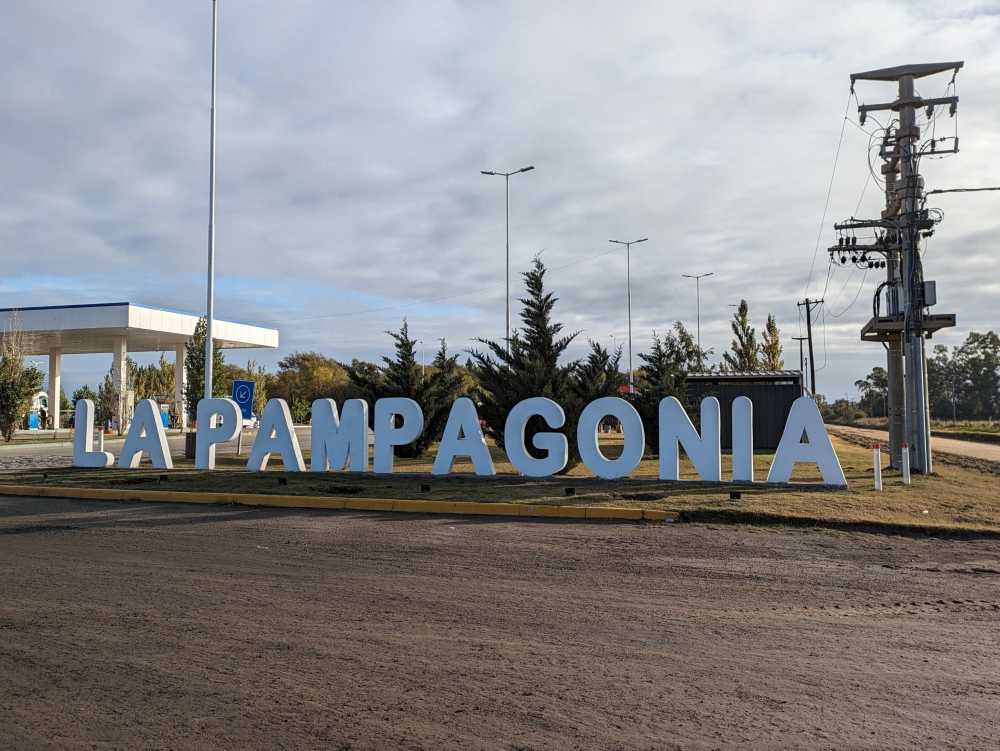
Realico
Our first driving day consisted of five uninspiring hours in the car on this flat stretch of Central Argentina. Because of the decent, straight roads, we could let our “pothole guard” down, listened to Spotify music through our Starlink antenna, and clocked decent fuel mileage.
Play on words in the province La Pampa
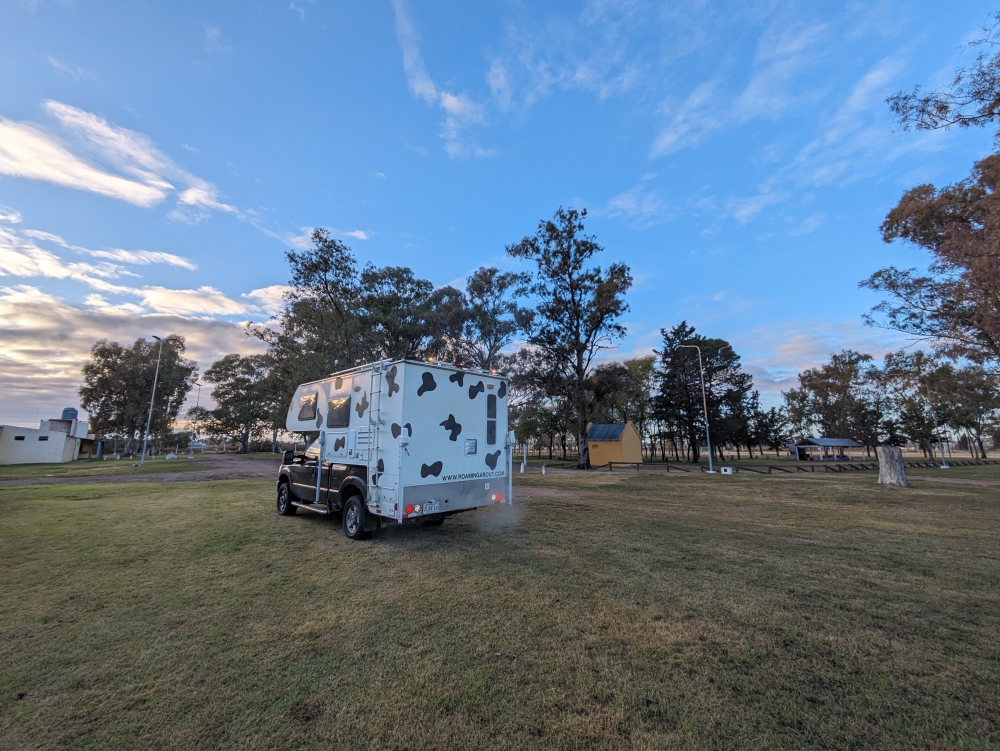
In grey, rainy, and cold Realico, we found many mosquitoes, a free municipal campground where we spent two nights, and the cheapest gasoline in months. Especially since the exchange rate for the peso had finally gone up. Three weeks out from temporarily leaving our life on the road behind, we started to plan meals around getting rid of all our food – dry and fresh.
Free Municipal Campground in Realico
Junin
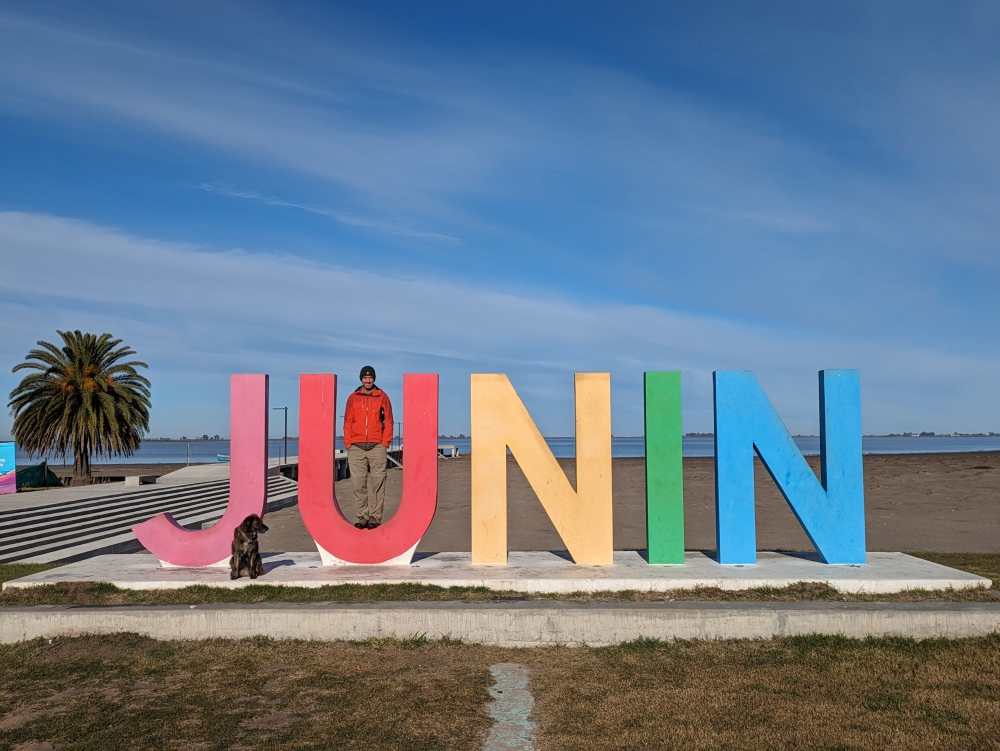
As I mentioned before, Mark and I never know what to expect when we pick a potential campsite in our iOverlander app. We usually have a back-up in mind, when things don’t turn out upon arrival. Well, after another boring drive east, Laguna de Gomez in Junin offered extensive areas of green grass, level spots, and a peaceful atmosphere. We loved it from the moment we arrived, took Maya for a walk, and settled in for a few days.
Colorful town sign of Junin
Except, this was the night I described in my expense report of May 2024; when the temperature dropped well below freezing, the butane in our propane tank failed to produce gas, and we couldn’t cook or heat our camper anymore. Mark poured warmish water over the tank after heating that up on the struggling pilot-size flame of our stove, which saved us from shivering more. We needed a better solution!
(As always, click on or hover over the photos in galleries to read their captions.)
The coldest night we’ve had so far!
Even the windshield was frozen!
Opening and airing out all our cabinets to fight condensation and mold
Our options: top up the now half-empty butane tank with propane, which would make everything function again in cold weather or move to a location where it wouldn’t freeze. Since it was a holiday Saturday, nobody would be able to sell us propane. So, after a nice walk with Maya and the discovery that our electric lock had a problem, we left our wonderful spot by the lagoon.
Cold but spacious Junin
Soaking up the sunrays by the reservoir in Junin
Funny bathroom symbols in Junin
Taking our electric lock apart
San Antonio de Areco
After another three hours of driving, we reached San Antonio de Areco, an attractive town not too far from Buenos Aires. Due to a parking ban, there is really only one decent place to wild camp, near the museum on the edge of town. The weather forecast promised above-freezing temperatures here and we would top up our propane tank first thing on Monday. Due to all the cold weather, condensation had become a problem and mold was growing in the seams of Bella’s walls. We attacked it with a bleach-water mixture and lifted the mattress with a fan blowing underneath.
A new friend for Maya
Airing out the mattress
The center of town was relatively attractive as far as Argentina goes (but still nowhere near as cute as its Colombians counterparts) and within walking distance of our camper. The nearby park was great for dog walks as well. A restaurant in the neighborhood threw awesome Sunday asados (grilled meat fests). While appealing, we passed due to the frigid weather. We hope to return for this meal in the future.
Cute historic bridge and river in Areco
Historic center of San Antonio de Areco
Church at the town square
San Antonio de Areco is a nice town to stroll around in.
Mark, Maya, and I would meet our Vermonster friends Heather and Jon in Tupungato, where we’d spent a few chilly nights previously, and travel together through Atuel Canyon and San Rafael for a week or two. If I complained about the cold in a previous blog post, well, winter seemed to have arrived early. That’s when living in a poorly insulated, solar-powered camper becomes less enjoyable.
(As always, hover over or click on photos in galleries to read their captions.)
Winter arrived in Central Argentina
Snow!
It is freezing outside
Tupungato
After hugging our friends from Meat Around The World goodbye in Mendoza, our trio drove back south to Tupungato. We would have loved to meet Heather and Jon at Bodega Giaquinta to buy more wine, but the new, restricted opening times didn’t fit our schedule, so we returned to the municipal campground. Our friends would buy extra wine and meet us there.
It might be cold, but it is pretty!
Fall walk in the campground with Heather and Jon
Maya making a new friend
This cute girl loved Maya!
We parked in the same spot, were accompanied by the same, wagging dogs, and enjoyed more walks among the fall colors. But, by now, it was way too cold and cloudy to sit outside or walk to the shower block. We used our own amenities, filled up with drinking water afterwards, and managed to plug into the electric system of our friends. This allowed our Lithium battery to finally charge to 100% – a huge help – which hadn’t happened in six months or so!
And, another campground dog enjoying Maya’s company
Our battery is 100% full; an anomaly in our camper this season!
It was wonderful to see our friends again and spend more time together. On this first evening, Mark made ossobuco and squash risotto for the group. Delicious!
Ossobuco dinner in Bella with friends
Mark cooked ossobuco with a tomato-parsley sauce and squash risotto
Manzano Historico
It was grey and it was cold, so we weren’t in a rush to explore the canyon yet. On the drive to Manzano Historico, we made a brief stop at Bodega Azul. We managed a little wine tasting and bought a couple of bottles of wine (Mark and I really like their Chardonnay), but the place was expensive and fully booked for lunch, so the atmosphere wasn’t ideal. We moved on early afternoon.
Brief wine tasting session at acclaimed Bodega La Azul
Wine selection at La Azul
Little did we realize our next destination was even higher up… That dawned on us when I saw all the roofs in town were white and wondered why. Snow! To our horror, the picnic tables were covered with the white stuff when we pulled into the municipal campground. We needed the heater here during the day as well.
The roofs have snow on them
Driving through the vineyards of Central Argentina – The background shows snowy Andes mountains on a clear day
Camped in Manzano Historico and plugged into our friends electricity set-up
I had it all figured out: I’d walk to the closest metro station from our wonderful free camping spot in Santiago, ride the line to the bus station, take a two-hour bus trip west to Valparaiso, explore the town during the day, and return home the same way.
Valparaiso in Chile
Valparaiso and Santiago de Chile
Then, our friends Abigail, Richie, and Zoe from Meat Around The World were interested in joining me. Great! Last minute, we realized that if we rented a car for the day, Mark and Maya would be able to come as well, plus this would give everyone more freedom and comfort than a return journey by public transportation.
Part of our group in Valparaiso (Photo courtesy of Richie Gubler)
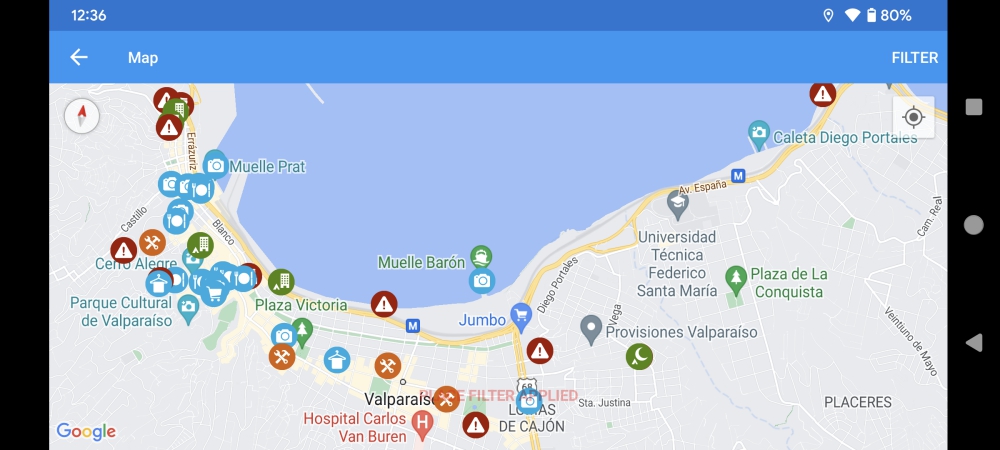
The reason we didn’t want to take our own campers was the bad reputation Valparaiso has regarding petty crime, car beak-ins, and tire slashings of foreign-plated vehicles. All of us had just installed new tires in Santiago, so now was definitely not a good time to take extra risks. There certainly is a grimy side to this port city.
Screenshot of Valparaiso in iOverlander – all the red and white warning signs mark robberies, break-ins, or tire slashings!
After a late start, a two-hour drive on fantastic toll roads, and finding a safe and covered parking spot for the rental car, the six of us set off on foot to discover the colors, murals, and old ascensores (elevators) of Valparaiso during the afternoon. Here is a photo gallery of our day as full-blown tourists.
(As always, hover over or click on photos in galleries to read their captions.)
Pastel-colored row houses
View from Cerro Concepcion
Look over the harbor of Valparaiso
A stately hotel on top of the hill
Colorful alley on Cerro Concepcion
Murals abound in alleys and streets
Girls will be girls – Zoe easily makes friends everywhere she goes.
Roaming About – Liesbet Collaert & Mark Kilty & Maya
We have been perpetual nomads as RVers, sailors, house and pet sitters, and overlanders since 2003. Currently, the three of us are roaming about Western Europe, searching for our next camper.
As lifetime adventurers, we are self-employed and maintain a tight budget. This blog is about all that – and more – to inspire a life less ordinary. Don’t dream but do! 🙂
This Daily Travelogue is a labor of love for our families and friends at home and around the world. Prior to 2020, all our trips were documented on yearly blogs which can be accessed below. THIS WORDPRESS BLOG IS A COPY OF OUR MAIN BLOG WHICH ALSO CAN BE ACCESSED BELOW. Be safe, stay healthy, and stay connected.