Roaming About

A Life Less Ordinary

Category: Van Living (page 1 of 14)

From Girl Time in Belgium to Vario Time in Germany & Our August 2026 Expenses 

Girl time with Maya

On the last day of July, Mark left for his annual visit to Massachusetts, USA, leaving Maya and me behind in Belgium for two weeks. When you live together 24/7 with your partner, it’s nice to have some me-time once in a while. Maya and I enjoyed this special time and bonded with lots of cuddles, attention, and walks.

(As always, hover over or click on photos in galleries to read their captions.)

That time apart also allowed me to meet up with four different girlfriends, which allowed us to talk in Flemish and foster our relationships without any hurry. One of my friends, Rosy, had just obtained an 8-week-old puppy, Bonnie, who joined her for our day together. Maya was the perfect oma.

I also cooked a lot, wrote a bunch, ran errands, did research, studied German, saw my parents frequently, called Mark daily, cleaned Duke’s interior, had long nights of sleep, witnessed the partial solar eclipse, visited my nephew for his twelfth birthday, and sweated a lot during more heat waves.

I finally met a famous overlanding couple when they passed through Belgium. I’d been online friends with Geneva (and her husband, Mike) from “It’s Not a Slow Car, It’s a Fast House” for at least six years, but we never managed to meet up before, despite coming close. Our morning together was a bit rushed, but it was still special. And they had brought a dissolvant product for us from the UK, which is not available in Europe. The Vario T2 remained front and center in our lives even while we were apart.

Another highlight for this reggae lover was watching the Wailers (yes, from Bob Marley fame) through a fence during the Fonnefeesten in Lokeren. Why through a fence during this free concert? Because, unbeknownst to everyone, event security didn’t allow dogs on the premises anymore. Two years ago, Maya joined Mark and me without any problems…

Continue reading

The Romantic Road in Bavaria, Germany – Medieval Towns, Castles & Surprises

Not too many people seem to have heard of – or been to – the Romantic Road (Romantische Straße) in Germany. When Mark, Maya, and I found ourselves at the southern end of it while visiting friends, it was a no-brainer that we would explore the area during our four days off. We actually had six days left before we needed to be back in Belgium, but the drive itself took two.

After little research and talking to Sabine and Michael in Murnau am Staffelsee, I created a short-list of the seven towns along this route that sounded most appealing. As always, we never researched much ahead of time or looked at photos. Actually, Mark had no idea whatsoever where we were going or how long we’d stay. So, the surprise and wow-factor were genuine for both of us.

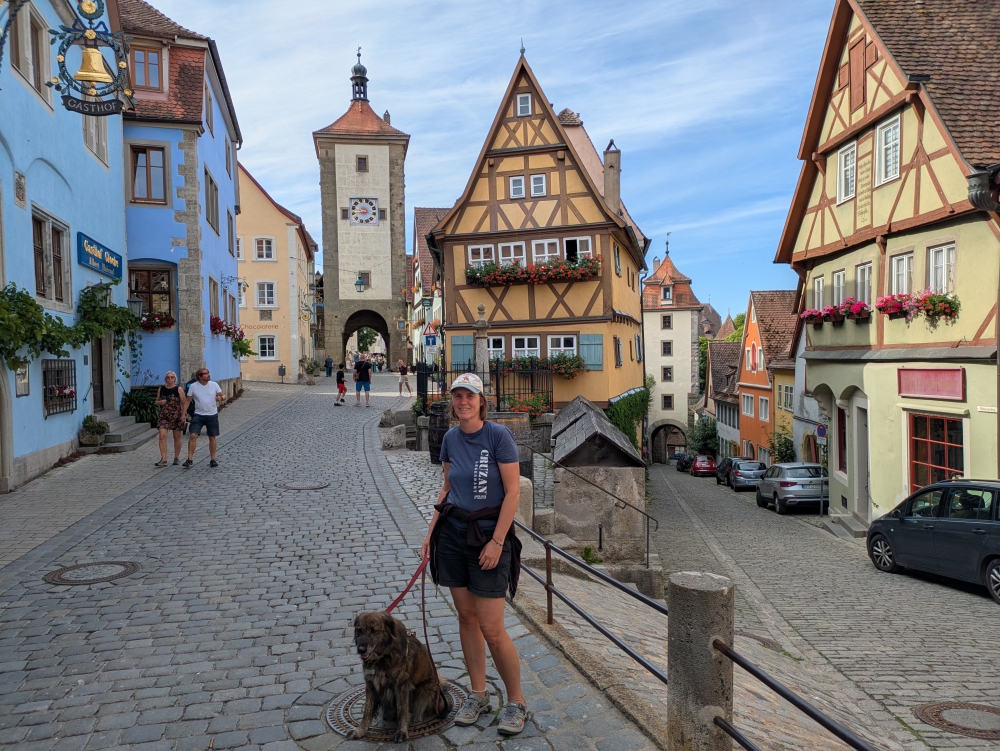
The most picturesque view in Rothenburg ob der Tauber

Schongau

Our first stop was only an hour or so away from our friends, whom we left in the afternoon. It was a quick drive and an easy, short visit since the town was small and we were camped at a free parking lot on the edge of the town walls.

(As always, click on or hover over photos in galleries to read their captions.)

Landsberg am Lech

The following morning, a short drive and a lucky break secured us the last spot on a free parking lot about 15 minutes by foot from the historic center.

Once we crossed the bridge into the heart of Landsberg am Lech, we were drawn to the watery ways and the colorful buildings. We splurged on a pastry while taking in the market area and its surrounding structures and gates.

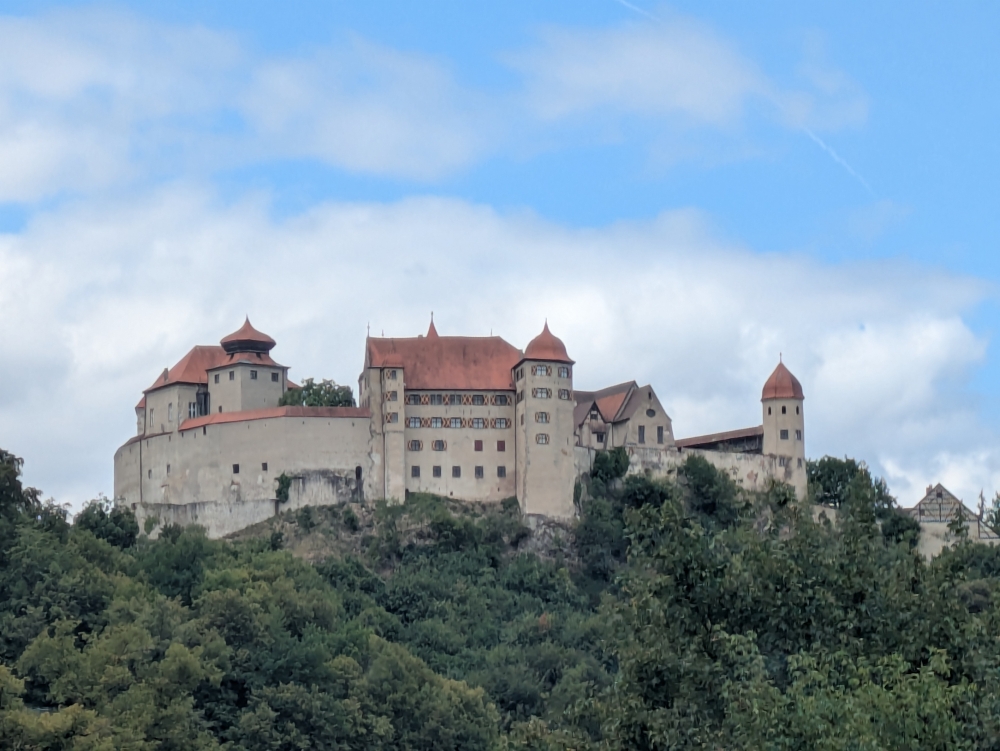
Harburg Castle

On this trip, I wanted to visit one castle. Harburg it would be!

Approaching Harburg Castle by camper

To our surprise, the dedicated RV parking spots alongside the popular river were open, so we doubled back and picked a spot. After our lunch with a view, we crossed into town and climbed a narrow trail towards the top of the hill. There, Harburg Castle awaited.

We paid our entrance fees, which I thought included access to the interior spaces. Maya was allowed on the grounds and – understandably – not inside the buildings. We could work around that, taking turns.

But our tickets only allowed us to visit the exterior areas. For the rooms, towers, and walkways, a guided tour was required. Unfortunately, we just missed the 2pm tour, and exploring the grounds took less than an hour, so I didn’t get my inside-the-castle look.

The actual village of Harburg looked cozy and picturesque as well, but we decided to move on since we didn’t have much time for this driving route and needed some relaxation as well.

Continue reading

WANTED: 4×4 Mercedes Vario

Readers of this blog probably know that Mark and I have been looking for a very specific van as our new home on wheels. With this vehicle, we hope to explore Europe and beyond – Asia, Africa, and the Middle East when safe again.

A 4×4 Vario in Germany

This next stage of our lives requires a robust, reliable, fixable, durable, and yet comfortable camper. That’s why we are looking for a 4×4 Mercedes Vario, as it ticks all those boxes. The living area and the cab are connected, the engine is almost bulletproof, and these vehicles are known to be resilient. The 4WD part is non-negotiable for us (there are plenty of 2WD versions available) as we plan to venture off the beaten path and know the importance of high clearance and four-wheel drive from our previous overlanding experiences.

But… this particular vehicle is extremely popular and difficult to come by and that’s why I am asking for help. If you know of anyone who might be thinking about selling their Vario or you have one for sale yourself, please get in touch.

Mark and I are interested in just the empty van (to build out ourselves/with a company) or in one that’s already converted into a camper.

You might remember that we have been looking for this type of Vario for a long time. I’d say for almost an entire year. First the research, then pursuing a few options in Chile (which all failed), and then in Europe and elsewhere in the world.

We have followed leads in Peru, Chile, Bahrein, Dubai, Germany (we just returned from a 12-hour drive to check one out that has too many issues and rust), and the Netherlands. It has taken a lot of time, effort, focus, and energy and we are running out of steam… Soon, we will need a different plan and approach.

Thank you for sharing our quest and spreading the word, especially if you are a fellow overlander or someone who knows these kinds of vehicles or owners.

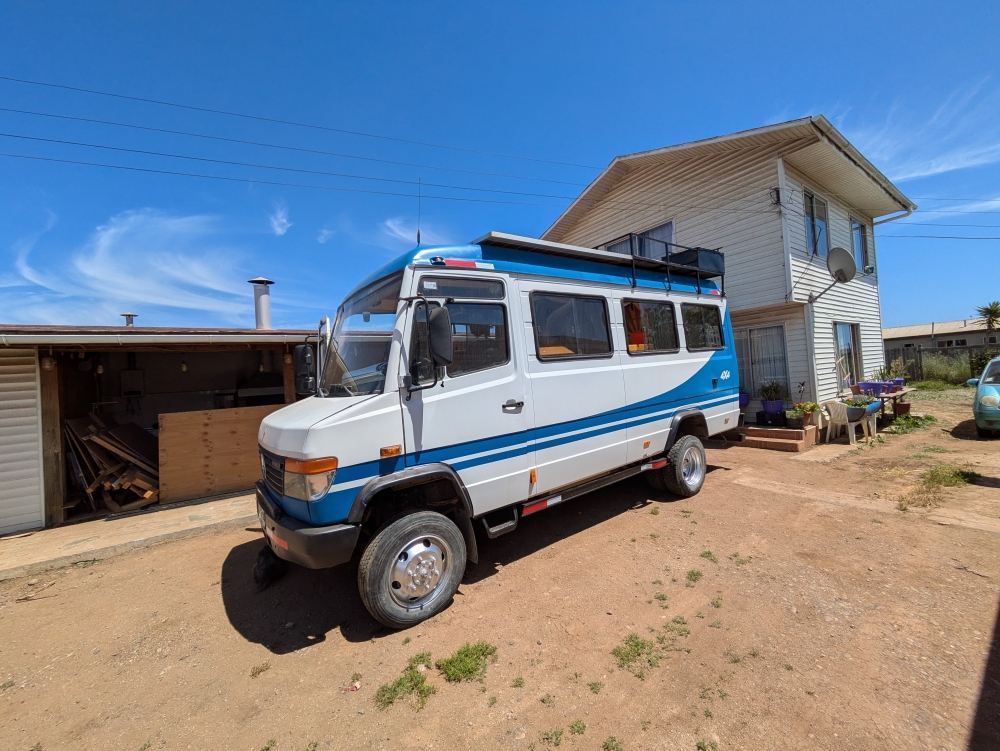
This is how our future camper would look like. This is NOT a 4WD version, though.

Happy May!

Our Crazy Mercedes Vario Idea in Chile – A Waste of Time?

Warning: This is a summarized yet long story about what we have really been doing the last four months.

I’m trying to remember when this crazy idea first emerged. At least six months ago, Mark was researching campers in Europe, since we thought/think this will be our new overlanding location. He must have stumbled upon a Mercedes Vario campervan, thought it looked cool and roomy, remembered our German friends Sabine and Michael having one, and focused his research on the 4×4 kind, only to discover that in Europe you need a special driver’s license for this “more truck than van” vehicle, prices wavered around a steep US$100,000, and there are many rules regarding registration, yearly inspections, insurance, and so on.

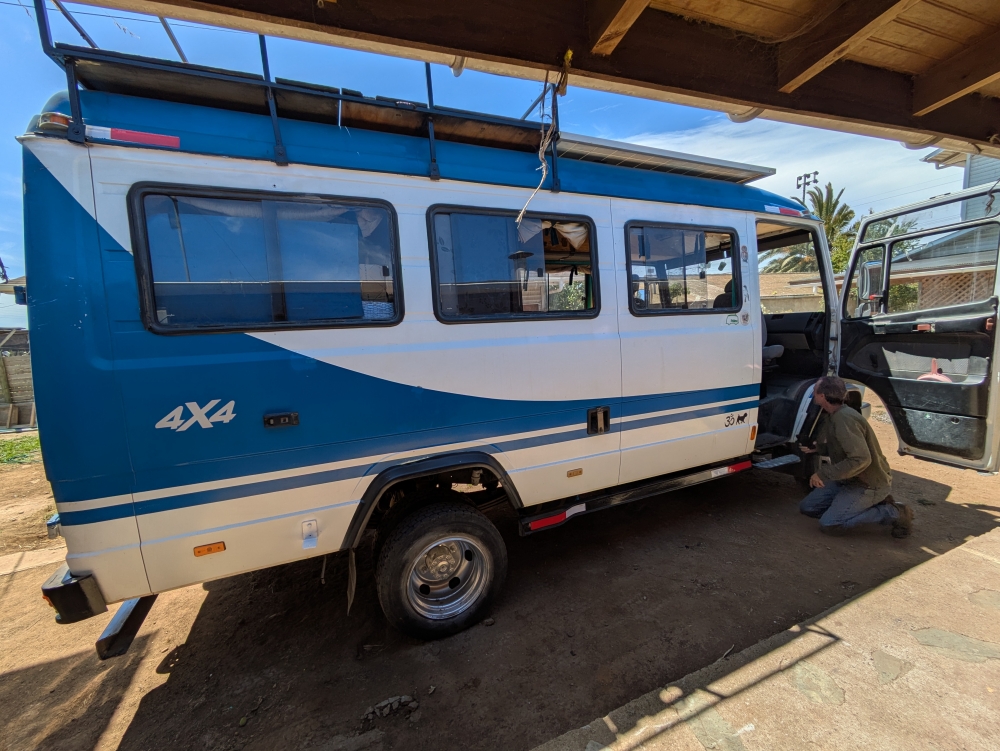
Driver’s side view of a Vario

It seemed like the Vario idea dead-ended right there. But on June 3rd (I checked my diary), an available 4×4 Vario appeared on the South America Overlanding Facebook page. There were only two problems: it was for sale in Peru with Peruvian plates and it was not converted yet. We inquired at a shop in Uruguay — the only place in South America we knew about — about how much it would cost to build out a van. More research followed and from the moment we realized that a vehicle can only leave Peru if it is owned by a Peruvian resident and that a new build would cost close to US$90,000, the idea was discarded again.

(As always, click on or hover over photos in galleries to read their captions.)

Fast forward to sometime in August when Mark discovered that Chile had imported hundreds of 4WD Vario vans from Europe to use in the mines as passenger transportation vehicles. Another problem arose: these vans had been well used and came with a bus door instead of a passenger door. Replacing that with an RV door would prove almost impossible, let alone dealing with the paperwork, the language, and other crazy logistics.

Soon after, Mark had a revelation. For months, he’d known about a Vario van that had been built out by a Chilean and had been for sale for a couple of years. It was located along the Chilean coast, four hours south of Santiago, but he hadn’t been interested because the camper section was poorly built and unattractive.

His revelation was this: it had a normal door and two seats in the cab, it was already registered as a camper (as opposed to a company vehicle), and becoming the owner of a new vehicle in Chile was straightforward and popular. It’s why many new overlanders buy a car or camper in Santiago to start their South American overland travels. Why not buy this crappy camper, gut it, and rebuild the living space from scratch?

Passenger side view of the Pichilemu Vario camper – with a normal door

By then, we had found out that there was a company in Santiago — Suzie Santiago CTW — that built out vans for a much better rate — but inferior quality — than the expensive shop in Uruguay. More research and communications followed with companies regarding the build and the paperwork. So many months of work and focus went into this pursuit! It’s pretty much all we did during our five weeks in Paraguay. We even drew up the perfect layout. Fun!

Continue reading

For Sale in South America: A Fully Contained and Well-Maintained Truck Camper

Start your self-catered South American adventure now! All you need to embark on this trip of a lifetime is a plane ticket and your personal belongings. 🙂

Bella in Chile

Mark, Maya, and I are wrapping up our three-year journey on the South American continent and are looking for a couple or small family that will enjoy our truck camper Bella as much as we have. If you know of anyone interested in an overland adventure with the perfect set-up for this part of the world, please let them know about our vehicle or share this post with them. We are very happy to answer any questions.

Thirsty Bella in Peru

Here are the details of our rig and a bunch of photos.

FOR SALE:

Fully Equipped Truck Camper – Ford F350 + Lance 830

This camper is set up for fulltime off-grid living and the vehicle is the perfect transportation to explore South America and beyond.

Price: $47,500 USD

Location: Argentina/Chile/Paraguay

Available: Now.

We speak English, Dutch, and some French and Spanish.

Registered/titled in the United States, easy transfer to any nationality via visitor.us.

You can also use a poder to travel while waiting for official US registration/title.

Camper and truck are meticulously maintained to provide care-free travel. Clean title/no accidents.

Likely one of the best equipped vehicles in South America with the lowest miles.

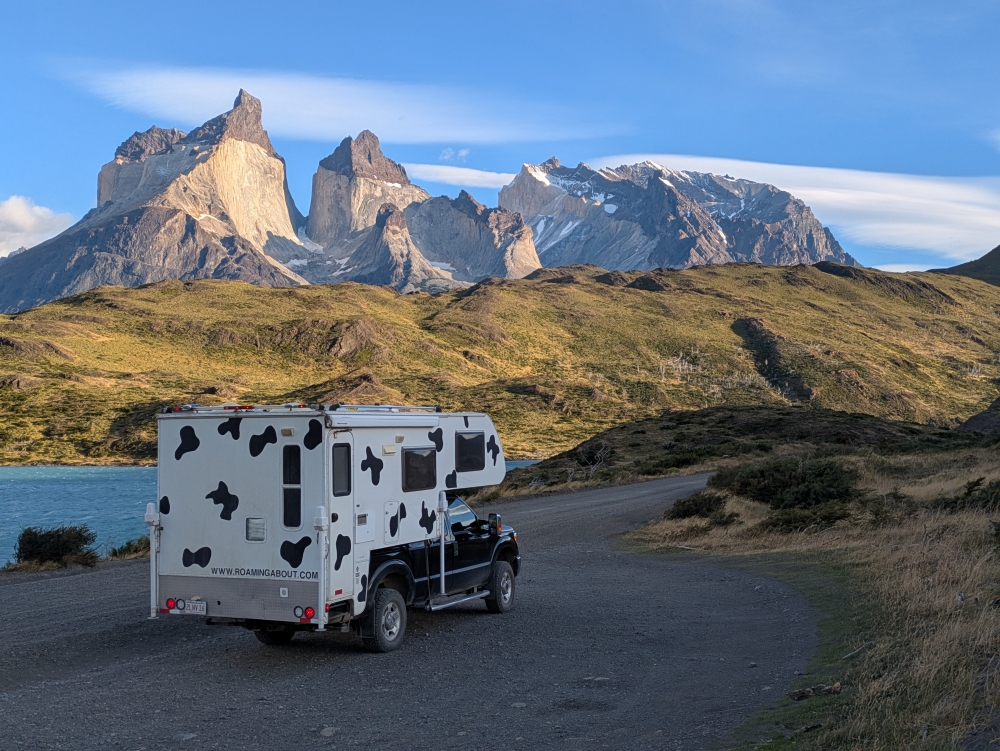
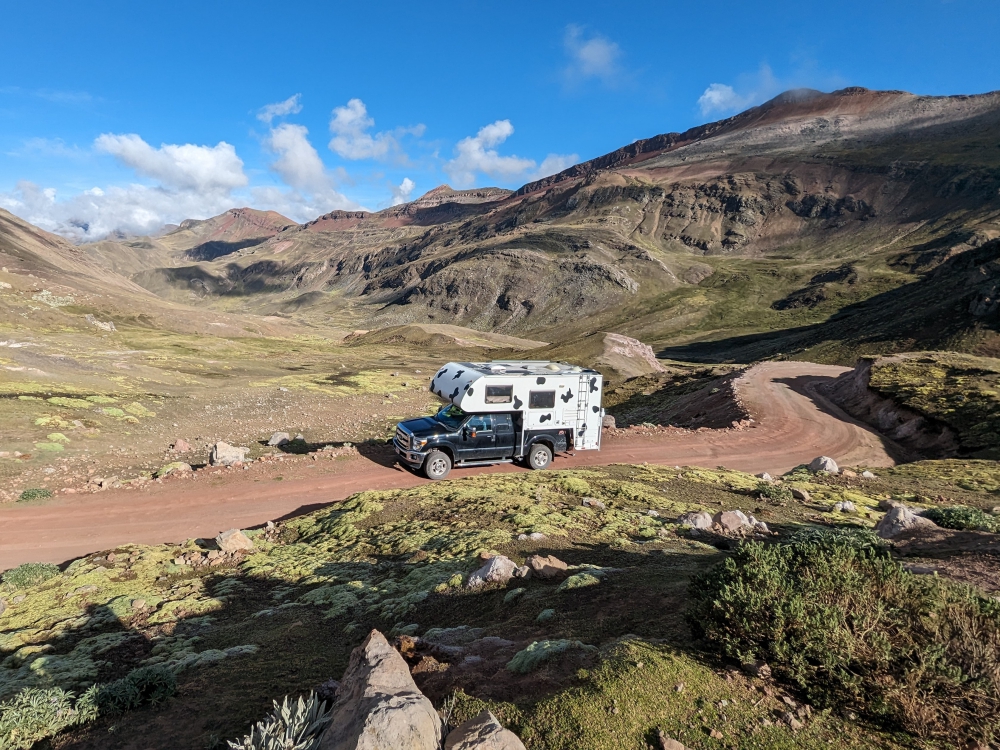
The cow décor brings smiles and laughs to the locals and allowed us to meet some great people along the way by giving them something to ask us about. We loved it and enjoyed making people smile during our travels. That said, the cow spots are stickers and can be removed if they are not your thing.

The camper can be removed from the truck to allow for exploration with just the truck.

Truck details:

  • Currently ~72000 miles.
  • 2016 F350 with 6.2L gas engine (385hp) and 6-speed automatic transmission. This engine/transmission combination is extremely reliable.
  • Front seating for 3, or 2 with a center console.
  • Extended cab with a back seat suitable for children and/or pets. Adults will be cramped. Seating for 3.
  • 35-gallon (132 liter) fuel tank.
  • Short truck bed (6’ ¾”) so it has a shorter wheelbase, which makes it easy to turn and maneuver.
  • 4WD with in-cab switch on demand.
  • Front hubs auto and manual lock.
  • 4WD High and Low.
  • Rear differential lock.
  • Flex-fuel compatible so no issues with high ethanol fuel in Brazil.
  • Power windows/locks. Windows in back doors are manual. Rear window in back is glass and electric.
  • Running boards along the entire cab.
  • Tablet mount on dash with wired USB-C cable.
  • Dash cam.
  • Moo horn (crucial safety equipment).
  • 3M security film on truck windows to prevent them from breaking (easily).
  • We are the 2nd owner.
  • Oil change every 5k miles with full synthetic.
  • Air filter changed every 20k miles.
  • Coolant changed at 40k.
  • Transmission oil changed at 70k.
  • Transfer case oil changed at 40k.
  • Spark plugs replaced at 60k.
  • Front brake pads replaced at 48k.
  • Rear brake pads replaced at 64k.
  • All oil and filters are Motorcraft/Ford.
  • Front tires replaced at 55k and rear tires replaced at 58k. AT tires with plenty of tread left.
  • Vair portable air compressor.
  • New truck battery 4/2024.
  • Heavy duty tow strap.
  • Titled in Massachusetts (US) and can be fully transferred to anyone (not just US residents) via visitor.us.
  • Spare parts: Oil filters, belt, ignition coils, front and rear brake pads, caliper pins.
  • Full set of tools with imperial and metric sockets, 3 torque wrenches, oil filter wrench.
  • Tools for electrical repairs.
  • OBD-II reader for Forscan Ford specific computer diagnostic software.
  • Full Ford workshop manual in PDF.
  • Truck is stock beyond the addition of Timbrens to help the rear suspension and Bilstein shocks all around.
  • Torklift camper tiedowns mounted to the frame of the truck for camper attachment.
  • Driven up to 15,500ft with no engine issues.
  • Total vehicle height with camper is 10.6ft (~3.2m).
  • 5-gallon jerrycan for extra fuel

Camper:

  • 2008 Lance 830. Very rare side-door entry truck camper. Roomiest floor plan for a truck camper this size.
  • Aluminum frame structure.
  • We are the second owners.
  • Outfitted specifically for off-grid travel in South America.
  • Standing height inside is about 6’ 3” (1.9m). I am 6’ 1” and fit comfortably.
  • Queen-size bed with 2” memory foam on top of spring mattress.
  • Dinette area for 4 people that converts to a smaller bed.
  • Wet bath with Separett Tiny composting toilet, wet shower and sink.
  • Kitchen with 2-burner stove, large and deep sink, 12V oven, and 12V Isotherm compressor refrigerator.
  • Water filtration system with .5-micron filter to allow for drinking tank water.
  • 4 large awning-style windows with shades and screens.
  • All windows and hatches have mosquito/bug screens.
  • 2 ceiling fans. MaxxFan above the bed (in/out) and Fantastic fan in bathroom (out).
  • LED lights throughout.
  • Permanently mounted Starlink wired to 12V with on/off switch. Mounted inside the camper in a ceiling skylight.
  • Permanently mounted router for use with Starlink. Gl-MT3000.
  • Large manual full-length awning on side of camper.
  • Outside LED lights on 3 sides of the camper.
  • USB charging ports.
  • Single 20lb US propane tank.
  • 2 heaters (propane). 1 forced air heater for when it’s really cold; also keeps tanks and plumbing from freezing. 1 catalytic heater that uses no electricity and is great for above freezing situations.
  • Gas grill with quick disconnect to use main tank for gas. No camping bottles needed.
  • 1 large outside storage compartment.
  • 48 gallons of fresh water. We added an additional 18-gallon tank to the standard 30 gallons. Plumbed together.
  • 17-gallon grey water tank.
  • 6-gallon hot water tank.
  • No black tank. Storage space now as that tank was removed when we installed the Separett.
  • Outside shower with hot/cold water.
  • 4 electrical jacks with remote control to take camper off the truck.
  • 400 Watts of solar panels mounted on the roof.
  • Victron 100/30 MPPT solar controller.
  • Victron Smart Shunt battery monitor.
  • Victron Orion XS 50A DC-DC charger. Charges from truck alternator.
  • Camper is wired for 120V. Can charge battery from a 120V power source (35A). A local transformer would allow you to plug into 220V outlets. We rarely had the need to plug-in for power because of solar and truck charging systems.
  • 500W pure sine wave inverter.
  • Single 272Ah lithium battery with Bluetooth management/monitoring.
  • Keyless entry on the door with a keypad (or key).
  • Fastgun turnbuckles to secure camper to the truck.
  • Camper connects to trailer plug of truck for all camper driving lights.
  • Camper connects via separate large Anderson style plug for DC-DC charging.
  • Tablet mounted on wall as permanent battery monitor connected to all Victron equipment.
  • Electric chainsaw to cut branches and small trees.
  • Spare parts for lots of things like electrical work, plumbing, caulk, repair tape, etc. Spare water pump. Spare water filters.
  • Lots of normal camping and household gear. Plates, pots, pans, glasses, outdoor chairs, bedding, snorkel gear, 12V vacuum, 2 camping tables, etc…..

Once you get used to maneuvering, the camper can be taken off the truck in about 10-15 minutes. It takes about 20-30 minutes to put it back on.

This flexibility offers the best of both worlds: you can leave the camper safe in a campground and take the truck anywhere you could imagine. For us, this combination of truck and camper is ideal for South America and we would not have done it any differently.

Original brochure: lancecamper.com/docs/2008-brochure.pdf

Video walkthrough: https://youtu.be/M-IlN4qigWk?si=YWeQ0TZigW7BUOXL

We have posted regularly on this blog if you’re interested in the full history of our overland travels thus far.

It is time for new adventures – for the new owners, for the camper, and for us.

Curious about a previous ten-year chapter in our nomadic lives, which includes eight years aboard a 35-foot sailboat in the tropics with dogs, check out my compelling, inspiring, and refreshingly honest travel memoir:

Plunge – One Woman’s Pursuit of a Life Less Ordinary

Available on Amazon and elsewhere

eBook: US$ 5.99

Paperback: US$ 13.99

Paraguay – The Underdog of South America (Part 1: First Impressions and Jesuit Missions)

Paraguay is a country often skipped by overlanders and tourists alike. With no world-famous attractions and sandwiched between popular Brazil and Argentina, it remains overlooked. But after traveling through increasingly expensive countries, Mark and I were more than ready for a change. Paraguay promised affordability, authenticity, and, according to our friends — sushi!

Encarnación: Entering Paraguay

We crossed into Encarnación on May 11th without any issues — unless you count Mark knocking over the customs officer’s mate cup. That moment confirmed a fun fact: in Paraguay, mate is served cold, unlike in Argentina. Another surprise? The now soaked and hand-written vehicle permit had to be recreated.

(As always, hover over or click on photos in galleries to read their captions.)

The city gave us a place to run long-delayed errands, save on gas prices, and visit a grocery store that had many items we couldn’t find or afford for a year. We loaded up, grabbed BBQ from a Sunday street stand, and sat by the river feeling like we’d finally entered another budget-travel paradise.

But reality hit that night: loud motorcycles, thumping music, and little chance of sleep reminded us that we were still very much in Latin America.

Life on the Waterfront (and a Sushi Dream)

Knowing Paraguay would be cheaper than Argentina or Chile, we’d saved up chores and repairs. In Encarnación, we tackled a camper ladder repaint, installed a mirror, and found transmission parts — choosing to do the work ourselves to save $400 in labor. The waterfront became our “work station.”

Despite the chaos, one night stood out: Mark and I finally went out for cocktails and indulged in a sushi boat at Hiroshima, a Japanese restaurant. We hadn’t felt that luxurious in years.

Jesuit Mission #1: San Cosme and Damián

Continue reading

A Surprising Side Trip to Santiago, the Capital of Chile

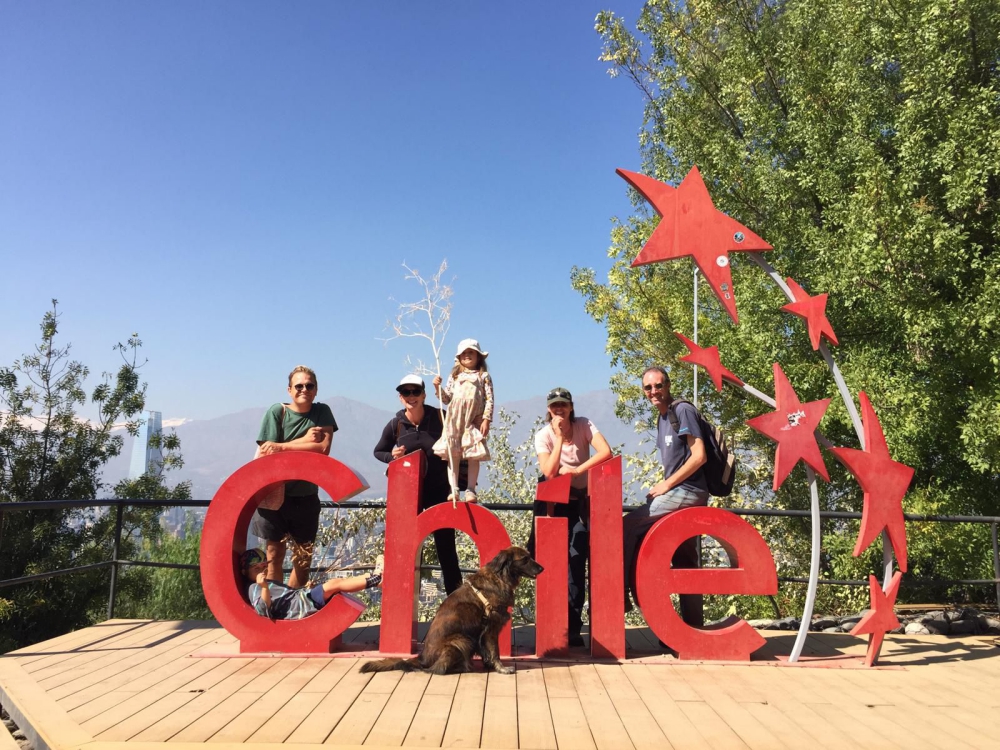
As overlanders, Mark and I are not city people. Being camped in nature without any human presence or noises is our happy place. Yet, the three of us spent a full two weeks in Santiago de Chile, a capital city of 7 million! This was our all-time “stationary” boondocking record after a year and a half in South America. Jardin, Colombia, is now the runner-up at nine nights. What happened?

Well, this lifestyle is full of surprises. Bad ones and good ones. It had been a while since fate smiled down upon us, but Santiago – which is expensive and not even an interesting tourist destination – ticked some of our required boxes. With ease. We were quite happy there. Read on to learn why…

Group shot in the park
(Photo courtesy of Richie Gubler)

Why back to Chile?

If you’ve been following our blog, you might have noticed that some hardships were encountered in Northern Argentina. Nothing disastrous, really, but after getting tired of similar issues in Peru and Bolivia, mostly regarding loose, aggressive dogs, dusty and dirty surroundings, and third-world living conditions, we had hoped for a reprieve of those in Argentina, especially after finding cleanliness and modernity in Northern Chile. When not finding that quite yet, we opted to return to Chile for a bit.

Another consideration was Maya’s international health certificate we obtained in Chile, the end of February. It was valid for sixty days, allowing free entries and exits for our dog between Argentina and Chile until the end of April. We figured we’d take advantage of that permit again, three weeks before it expired.

But the most important reason for our little sojourn back into Chile was truck maintenance. Imported parts are much cheaper there than in Argentina, as we realized when buying our first set of two new tires in Iquique a couple of months ago. Unfortunately, we didn’t purchase four at the time.

That being said, we chose Santiago to replace the other two tires, install a new battery, and do another oil change. Yeah, our expense report for April won’t be pretty again…

Our Providencia neighborhood in Santiago by night
(Photo courtesy of Richie Gubler)

Our fantastic camping spot

The biggest surprise that greeted us in Santiago was the place we opted to wild camp at, based on reviews in iOverlander. It was easy to see why every overlander seemed to flock here!

(As always, hover over or click on photos in galleries to read their captions.)

Continue reading

A Month in Northern Argentina – Dusty Towns, Pretty Vineyards, Wonderful Wine & Scenic Drives

“The scenery is amazing!” “The people are so friendly here!” “Everything just works!” “Argentina is dirt cheap!” – These were the sentiments shared by fellow overlanding friends when they arrived in Argentina, many months before we did. People loved the change of scenery, culture, attitude, and quality of life, once they crossed that “last” border.

Mark and I couldn’t wait to visit. But, sometimes, slow travel bites you in the butt. In March 2024, when the three of us finally arrived in Northern Argentina, prices for everything had doubled, if not tripled or quadrupled, and the excitement of other travelers was lost on us. Because we are on a tight budget? Because we travel with a dog? Because we came from “westernized” Chile with immaculate paved roads, leashed dogs, friendly drivers, clean cities, and modern feel?

In a nutshell: We had expectations when we crossed the border (and that was our mistake, really; we know better than to have expectations). Yet, what we – initially – found were dusty towns, lots of trash, dangerously grooved roads, ear-piercingly loud motorcycles, the smell of burnt garbage, and loose dogs. There were also a lot of indigenous people, unlike in Chile. Northern Argentina felt like an extension of Peru and Bolivia, and it was NOT cheap.

Apart from those experiences as vehicle drivers, long-term travelers, and dog owners, of course there was beauty, joy, and excitement to be found as well. Why else would we still be on the road?

Our destinations in Northern Argentina

Susques

After a beautiful drive, a smooth and efficient border crossing in Pasa Jama, and a disappointing money exchange (our crisp U$100 bills weren’t as crisp as we thought, and the blue dollar “tourist” rate had dropped a lot), we spent our first night near the town of Susques, which has a cute adobe church.

Here, we had to choose between the famously pretty but bumpy Ruta 40 South or the paved comfort of Ruta 68. We picked the easy solution and are happy we did as it delivered beauty in the form of scenery and new friends.

Salinas Grandes

Before reaching our first real tourist town, we stopped at the salt flats of Salinas Grandes. We’d hoped to visit the Ojos, clear pools in the middle of the Salar, on a short van tour, but because of recent rains, this part was too wet to drive on. So, the three of us just walked around the salty terrain with its clear-blue canals – and Maya was a mess!

Purmamarca

In Purmamarca, we only anticipated a hike among the colored mountains. It was a hot afternoon, but the fee for the trail was low and the surroundings bright and attractive. When returning via the center of town, we liked it so much that we decided to spend the night on the sloped parking lot we had pulled into earlier. The pleasant atmosphere of downtown – and the prospect of dinner at a pizza restaurant that didn’t open until 8 pm – had us change plans.

Continue reading

Off the Beaten Track Waterfalls, Lakes & Small Towns — Traversing Colombia’s Mountains on Dirt Roads

The negative about writing these blog posts three months after the facts means that I don’t remember all the details. Like when I’m behind with my diary for a few days – which often happens. A positive – in case of the diaries anyway – is that I don’t remember all the details. So, instead of an hour, such an entry takes half an hour to write. ????

Pretty mountain drive

All this being said, I remember Mark and I wanted to do something different after leaving the sinkholes of Las Gachas: driving to the municipality of Paipa across the mountains, via dirt roads. Why is this such a big deal? Because there is no information available about secondary, or tertiary, routes in Colombia.

(As always, hover over or click on photos in galleries to read their captions.)

A lot of rain falls in this country, causing landslides every day. Our thoroughfare might be blocked by fallen trees, piles of dirt, rocks, or other objects. Or, the road might be gone, crumbled down a cliff. In other cases, the streets might be too narrow or low due to overhanging trees. Our truck camper Thirsty Bella is big. In Colombia it’s not an issue of “When will we get there,” like in other countries, but “Will we be able to get there or do we have to turn around hours into the voyage?” Such is the kind of adventures we embark on these months.

After quickly visiting Guadalupe, filling our fuel tank, backtracking over the narrow, potholed road to the main “highway,” following that south for a couple of hours, and turning off for the rough “shortcut,” we reached Gambita. We descended into this small town, still in the department of Santander, after asking locals if our rig could navigate the narrow streets. It could. Barely.

Continue reading

Our Colombian Christmas Story – From Horror to Hospitality

DISCLAIMER: This is a real-life story, nothing more, nothing less. Just like when sharing a previous, relatively scary experience about a car burning out next to us in a remote area of the Baja Peninsula, Mexico, a year ago, I’m not looking for sympathy, concerns, warnings, or criticism. Also, like the previous story, this one has a good ending. Bad things happen everywhere. We are aware of that and realistic about it. In the twenty years of being nomads, this was the very first time we felt unsafe. And we do not blame it on Colombia or its people.

(As always, hover over or click on photos in galleries to read their captions.)

The Setting: Gramalote Viejo, Norte de Santander

After spending about a week in Playa de Belen in the department of Norte de Santander, Mark, Maya, and I drove many hours into the mountains, up and over terrible roads consisting of rocks, gravel, bumps, and potholes to reach Gramalote Viejo in time for Christmas. Our friends Sheri and Jeff had already arrived in their truck camper. They drive faster and had less errands to run. 

We parked by the spooky remains of a church, on cracked pavement with weeds poking through. Next to us sat the ruins of a town square and a dilapidated gazebo we repurposed as our happy hour patio.

A peek behind the slanted, still existing church façade revealed old crypts with human bones, most of the cubby holes plundered. Vegetation had taken over the church property and an eerie atmosphere lingered. 

Continue reading
Older posts

© 2026 Roaming About

Theme by Anders NorenUp ↑