On February 1st, Mark, Maya, and I left Lisbon in a rental car and joined our friend Patti at her rental house along the Piedras River in El Rompido. We stayed for the final two weeks of her three-month stint there.
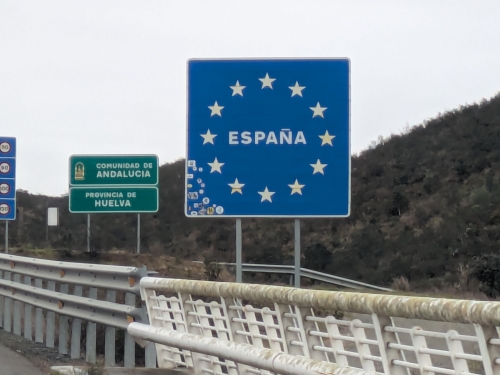
Welcome to Spain!
While the setting and views were lovely, the weather didn’t cooperate. Long beach walks and outdoor happy hours were off the table.
(Hover over or click on photos in galleries to read their captions.)
Sporty Patti with two of the dogs
Koozie soaking up some sunrays on the balcony
That said, whenever sunshine was in the forecast, we made the most of it — heading into the Algarve of Portugal for day trips to visit my parents or explore with our friends Heather and Jon. One particularly good morning, our little group — three people and three dogs (Patti has two of her own) — managed to get some exercise along the river beach and through the nearby forest.
Cloudy walk on the river beach
Fishing boats on the sand
The house itself was spacious but cold. Luckily, we had a small electric heater in our room, which made it possible to warm up and get cozy under the covers. Patti, on the other hand, prefers cooler temperatures — a difference we definitely noticed. 🙂
Dinner at Patti’s rental
Vegetarian frittata
Flooded streets in El Rompido
Three relaxing doggies
More rain led to flooding
Despite the chilly, rainy conditions and busy days, our evenings were enjoyable and social.
Sunset after another rainy day
Indian curry on the stove
Social with friends
Comfy Maya
Enjoying an Indian-style lunch with friends
We indulged in home-cooked dinners, fabulous wine and port, and great conversations. At night, we sometimes watched the Winter Olympics together. Our trio even hosted an Indian curry lunch for one of Patti’s friends and were invited to a traditional Spanish tapas and tortilla meal at a neighbor’s house.
Authentic Spanish lunch at a neighbor’s house
The Spanish tortilla
Is the sky finally clearing up, after two miserable weeks?
Cádiz
Patti had bought a car in Spain, which needed to pass inspection in Cádiz. Since it was a 2.5-hour drive each way, she appreciated having company. With questionable weather in the forecast, Mark stayed behind with Maya and Koozie, while Patti, Pekoe, and I turned it into a day trip.
During our last three weeks in South America in December, Mark and I needed a “What’s Next?” plan. We had just sold our truck camper in Chile and were officially homeless. Finding our next campervan would likely take a while — we’re very picky. (If you have a Mercedes Vario 4×4 for sale or know someone who does, please let us know!)
After more than two decades as nomads, we don’t really have a home base. Mark’s niece and her husband moved into “our” room above the garage at his mom’s house in Massachusetts, which is a win-win for everyone involved. Living in “our” guest bedroom with a shared bathroom in the middle of a New England winter would only work for about a month. So where could we go after that?
Renting a place in the Caribbean for a few winter months was too expensive. We didn’t want to go to Belgium yet to stay at my parents’ “little house,” because winter there is cold and rainy — and Mark can only stay in my home country 90 days out of every 180. It made more sense to use those days closer to summer. And we were ready to leave South America and its Hispanic culture.
Then an opportunity appeared. A friend invited us to stay at her rented house in southern Spain for a couple of weeks. My parents would also be nearby for their winter break. Add our curiosity about Andalusian villages and the discovery that Mark, as my spouse, didn’t have to do the Schengen shuffle while traveling with me — and the southern Iberian Peninsula became the obvious destination.
Yes, the irony of going from Hispanic South America to Hispanic Spain isn’t lost on me. There are plenty of similarities, but luckily some differences too. 🙂
We started in Lisbon, Portugal, mainly because rental cars were much cheaper there than in Spain, and we could take a direct flight from Boston with Maya. Our plan was to stay in the region for two months and then slowly make our way to Belgium – by train! – in early April. That would be the real adventure of this trip.
The Blogging Plan
This year, I had hoped to publish simple monthly wrap-ups. But honestly, we are doing and seeing so much — way more than we did in South America — that those posts would become ridiculously long.
Writing chronologically and geographically is tricky as well. During our first two weeks in Spain, we actually spent more time in Portugal. So I’m splitting that period into two blog posts: one highlighting our visits in Portugal, and the second focusing on southern Spain.
The Algarve — Part One
Faro
On February 1st, we brought the rainy and windy weather with us from Lisbon to El Rompido, Spain. After a wet drive without mountain views, we greeted our friend Patti and stayed indoors for the next few days, trying to be warm and dry.
Leaving Lisbon in the rain
Spain, here we come!
On the first decent day — which turned out sunnier than expected — Mark, Maya, and I drove to Tavira to meet and pick up my parents. It had been a year and a half since we last saw each other in person.
And, back into Portugal for sightseeing
Seeing my parents again after a year and a half
We didn’t need an early start because crossing the border into Portugal meant gaining an hour. In theory, we would arrive at the same time we left, since the drive itself took about an hour. Of course, that also meant the return trip would take two hours. 🙂
(As always, hover over or click on the photos in the galleries to read their captions.)
The airport of Faro is close to its historic downtown
The main entrance to the old town
Downtown Faro
Walking in the historic downtown of Faro
Lavish building within the walls
Tiled facades again
The Cathedral of Faro in the historic center
A pricey but tasty three-course day dish with seafood, a drink, and olives
The place to have lunch!
Our little family group spent part of the day exploring historic Faro — wandering narrow streets, having lunch on a sunny patio (Maya wasn’t allowed inside), and strolling along sections outside the old city walls.
The city sign with Maya
My dad leaning on the F of Faro
Roaming the streets of historic Faro
Maya meets another dog.
Stork on the roof of the gate
Leaving the old town through a different gate
The elaborate gate seen from the outside
Another historic building outside the old town
A different side of the city
Church along the way to a more impressive church
Mark, Maya, and I in front of the Igreja do Carmo in Faro
The bell tower of yet another church
No excuse to leave dog shit on the sidewalks!!
Tavira
Since we had time left that afternoon, my parents introduced us to Tavira, another beautiful town. As usual, we hadn’t done research beforehand, which meant every corner of the historic center revealed something new and charming.
The Roman Bridge in Tavira is a 17th-century, 7-arch stone pedestrian bridge spanning the Gilão River.
Pretty building across the river
Chapel in Tavira
Church tower aiming for the sky
Old fort walls
Mark and Maya on the fort walls – Can you see Maya’s head poking out?
When Mark, Maya, and I arrived in Lisbon, Portugal, after a bad experience with the airline company TAP Portugal, there was a lot of talk about “the storm” that had hit the southern Iberian Peninsula on the evening before our arrival and which had caused some of our delays. For the first time, we checked the weather. It didn’t look promising.
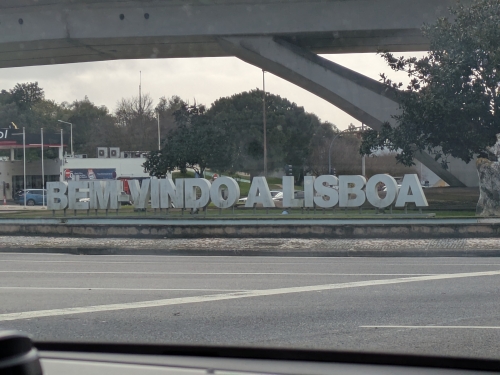
Welcome to Lisbon, Portugal!
There was more rain — and wind — in the forecast, but we would make the best of our four-day stay, despite already missing out on a free taxi ride promised by Booking.com (because we had to postpone our arrival), moving our accommodation out for two days, having less time on the peninsula, and needing to pick up our rental car earlier than expected.
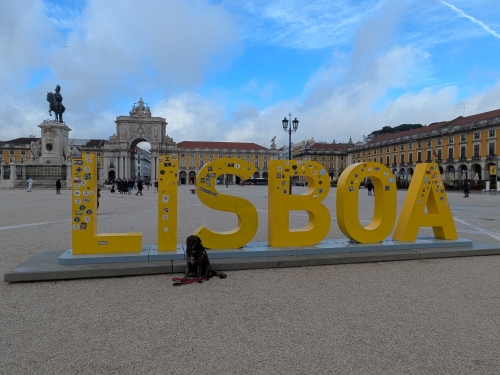
Maya in front of the Lisbon sign
Since we had a six-hour delay (in addition to the two-day delay because of the blizzard in New England), we had to skip our nap upon arrival after a red-eye flight. All these experiences helped with our need for flexibility and resilience. We were not going to complain. Not even about our tiny and moldy, wet apartment, where nothing dried. Because its location in Alfama was perfect. It was our first time in Portugal. And we had finally arrived in Europe!
(As always, hover over or click on the photos in the galleries to read their captions.)
Half of our luggage and Maya on the cobblestones of Alfama, Lisbon
Small bedroom
Small dining room
Maya loved “her” couch in the small apartment.
Dated kitchen
Tiny bathroom
Day one
Since it was noon by the time we checked in, we hit the cobblestone streets after taking a shower and settling in. We decided to try a typical local lunch of grilled sardines and a white fish. For some reason, I’d forgotten that serving entire fish with all the bones — and sometimes intestines — is a thing in Europe. While the flavors were great, I’m a lazy person when it comes to eating. The less work, the better. 🙂
Only fish with bones
Alfama alley
Lone winter tree in Alfama
One of the main roads in the Alfama neighborhood of Lisbon
Many displays of azulejos – white and blue tiles typical of the region
Strolling around the Alfama neighborhood
Many houses have tiled facades
Panteao Nacional
Tiled buildings
Detail of the tiled walls
My first pastel de nata pastry: yum!
In the afternoon, we explored the cute and mostly pedestrian Alfama neighborhood, climbing its hills, strolling its cobblestone streets, and eating my first of many pastéis de nata. For someone who loves pastries and pudding, this treat is heaven!
One of Lisbon’s churches
The tram is a popular way to get around the city – We never used it.
In November 2022, Mark, Maya, and I started our latest adventure by staying at Airbnbs in Cartagena, Colombia, stressing about the arrival of our home on wheels. One rental apartment turned into five different ones, just like the expected one week of waiting turned into five weeks.
All the while, we had no idea if and when we would be reunited with Thirsty Bella as we refreshed the page of the shipping company schedule every hour for updates. Day after day, things went wrong and delays continued. We could not plan or prepare for anything and our stress level went through the roof, as we wasted precious time and money. We almost flew back to Texas and abandoned this journey. I wrote about that giant ordeal here.
Fast forward three years and we found ourselves at an Airbnb in Chile’s capital, Santiago, stressing again, but about different things. Ironically and fittingly (as irony and bad luck keep finding us, the perfect victims of Murphy’s Law), we ended our three years in South America in a similar way as we’d started them.
(As always, hover over or click on photos in galleries to read their captions.)
Time to organize and purge the rest of our belongings after moving out of Bella
Goodies we brought from Bella for our next camper
It was very nice to have a couch.
When Mark, Maya, and I handed over our truck camper Thirsty Bella and arrived at our city accommodation for three weeks before flying out of Chile, we had three goals: finally rest up after the stress and commotion of the last months, eat good food at home and in restaurants, and make a plan for 2026. One would think that three weeks would be plenty for this. Of course, we still had to take care of the usual work, living, and dog requirements while being “homeless.”
A curry Mark made at home
Having a full-size oven meant we could make our staple pizzas from scratch again.
Our meal combos were a bit odd at times, since we wanted to “get rid” of all our fresh foods before leaving the country.
We splurged a bit more than usually on our Airbnb, picking a modern apartment that had air conditioning and a washing machine. Both were well utilized and appreciated! Unfortunately, buildings in developing nations aren’t built the same as in first-world countries.
Our living space was roomy enough
I loved this washing machine with a combo dryer! We used it a lot.
Which brings me to our craved rest. Our Murphy bed was extremely creaky each time one of us moved and the mattress was hurting our backs. We usually like hard mattresses, but this one was too much. After a few painful nights, we took the mattress off, stuffed extra duvets between it and the bottom sheet, and stored the frame of the bed in its cabinet. Yup, we paid good money to sleep on the ground, but this change helped our poor backs and ears.
The Murphy bed that creaked and didn’t quite work
Our redesigned bedroom
Our USB-fan vibrated against the wood of the cupboard, creating somewhat of a white noise
The next issue was the person who lived above us. She (since we heard what sounded like high heels clicking back and forth) was awake every and all night, walking around, moving furniture, frequently dropping items. We heard it all. Even her bathroom movements and toilet flushes. Once we were asleep it didn’t bother us too much, but, when awake, there was no way of dozing off again. The noise also kept Maya up and restless, because she hates stuff “falling” on the ceiling — whether it is in a camper or an apartment. A USB fan we brought from Bella helped create “white noise.” When the pounding was too loud, I used our broomstick to hit the ceiling.
Our kitchen was missing necessary items, but that wasn’t an issue as we’d brought stuff from the camper that were duplicates or gifts. Construction in the hallways happened about half of our days there and every bit of commotion seeped through the thin door, but we did appreciate being on the back side of the building instead of alongside the busy road.
The kitchen was spacious and decent.
The luxury of renting an apartment across a Grido store: a freezer and fresh ice cream!
This was the only cheese and carrot grater – not big enough!
When I realized early last year that I would turn 50 in 2025, I promised myself to do something special for this milestone occasion. But I had no idea what this would be yet. Because of our flexible lifestyle and undetermined schedules, who knew where we would end up in November? It could be Brazil. Or Chile. Or back in Colombia.
Once we secured buyers for Thirsty Bella, whom we would meet in Santiago de Chile at the beginning of December, my excitement for a destination grew. I’d always wanted to visit Rapa Nui (Easter Island), which belongs to Chile. Mark and I actually had plans for a week-long vacation there in 2014, when we were sailing in French Polynesia. But fate had something much less fun and more impactful in mind twelve years ago. So, we hopped on a plane to the US instead of Rapa Nui to deal with Mark’s health.
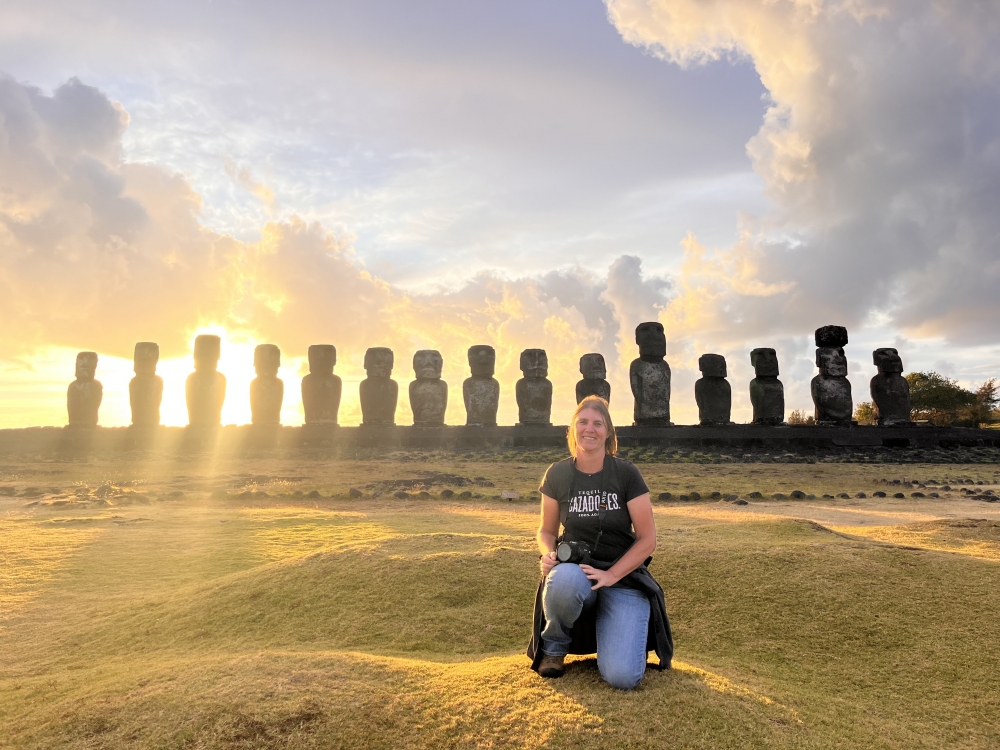
Sunrise on Rapa Nui/Easter Island
This magical destination had always been in the back of my mind. Now that I’d be in the capital of Chile, the only place left with regular flights to Hanga Roa, the main town of Easter Island, it was the perfect time to book this trip. Unfortunately, prices for everything—from hostel rooms to flights to the national park fee—had gone up immensely since the pandemic. I sucked it up, yet tried to keep my five-day excursion as cheaply as possible.
(As always, click on or hover over photos in galleries to read their captions.)
Ready for my flight to Rapa Nui!
Our route – Easter Island is not close to anything.
I was the only one on this big, commercial plane wearing a mask
Our plane has landed in Hanga Roa, Easter Island
A welcome sign and local drummers
With only one personal item (Latam Airlines charges extra for carry-on bags as well), I took a cab to the airport early on November 16th and hopped on a plane for five hours. This domestic flight was comfortable and smooth. There was entertainment and—to my surprise—a meal was included. When exiting the plane, passengers were welcomed with Polynesian drumming and dancing. I felt immediately transported back to the South Pacific of our sailing days. It felt great! I had missed the islands and the culture.
To save money, I walked the half hour—a bit overdressed—from the airport to my hostel, enjoyed the views of the ocean and some old and newer statues along the shoreline, and was settled by 2pm, ready for my solo adventure.
Walk along the shoreline to reach my hostel
Another piece of art along my first walk
One of the modern statues along the way
The town’s man-made swimming beach and bay
One of the many statues along the waterfront
The first moai-looking moai I passed by
I have arrived!
This was the moment that I felt I was really and actually on Easter Island
That first afternoon, I had hoped to book a “full” island tour, buy my mandatory national park ticket, inquire about activities, and get my bearings. But because it was Sunday, I couldn’t do much more than explore the town of Hanga Roa and enjoy my first sunset over the moai of Ahu Tahai.
The view from across my hostel
I really liked the grassy areas along the waterfront, made for relaxing.
One of the two protected harbors on the island
Turtle!
Side view of one of the moai along the town’s shore
A different view from the harbor near me and its colorful boats
Sunday at the beach!
I had three full days to take in the sights of Easter Island. My return flight would leave on the afternoon of day five. It seemed like plenty of time.
Almost time for sunset
First sunset on Easter Island
Sunset at Ahu Tahai
On Monday, my plan was to hike along the northern shore and end up at a couple of national park sites to peek at. I had bought my pass for $102 (which had gone up that month from $75 and the bad exchange rate with the US$ made it even more expensive), but most of the sites are only accessible with a guide. Another change since Covid.
Nevertheless, I enjoyed strolling over the bluffs and the volcanic rocks, following horse trails, and spotting the “sunset statues” by day, without the crowds. Statues on the island were erected to honor the (affluent) deceased and later in history, (mass) burials took place underneath the platforms.
Revisiting Ahu Tahai the following morning
View over the platform and a single statue
One of the most-defined statues on this platform
Looking back towards Ahu Tahai and the top hat statue
Restored moai with eyes and a “top hat”
Continuing along the shoreline, I passed another single moai and eventually, I walked through a gate where I was immediately yelled at and kicked out by a ranger. Luckily, a more friendly local gave me a ride back to the village.
Sea crashing over the rocks along the north shore
Walking along the coast towards another moai
I really liked this guy.
My walk along the shoreline revealed another, single moai.
Close-up of this solitary moai
Many rocky bays along the north shore
Leaving the horse trails to follow the main, dirt road for a bit
Naturally carved out rocks
Rubble and ruins along my track
Walking back along the road after being “tossed out.”
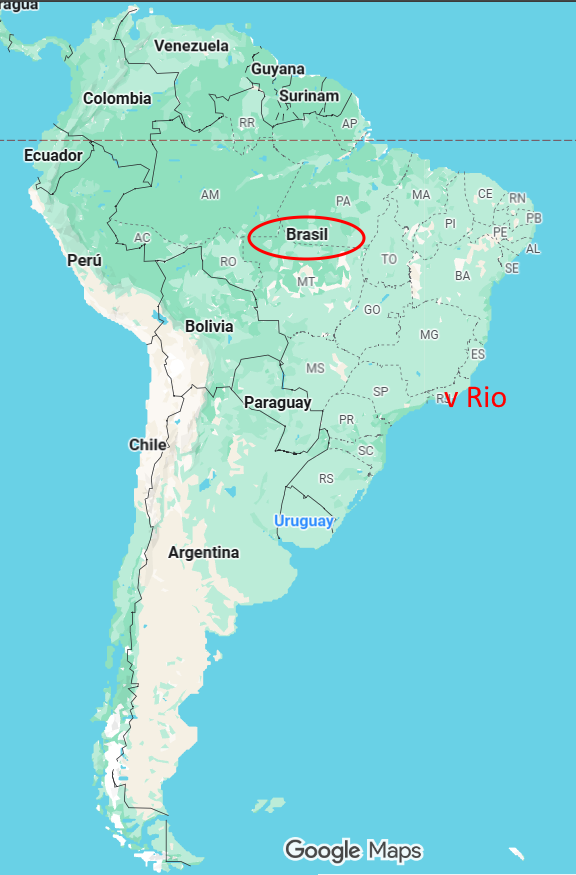
When we left Rio de Janeiro, the idea was to meander up the coast and eventually make it to the state of Bahia to reconsider our route and plans.
Since our camper is for sale, we had to be flexible. The issue with Brazil is that it is huge! And because, as Americans in an American vehicle, Venezuela is off limits for safety reasons, we couldn’t drive the northern loop back to Colombia. This meant that wherever we drove in Brazil, we would have to backtrack that distance south in order to leave. There are no (decent) roads in the Amazon.
Brazil in South America
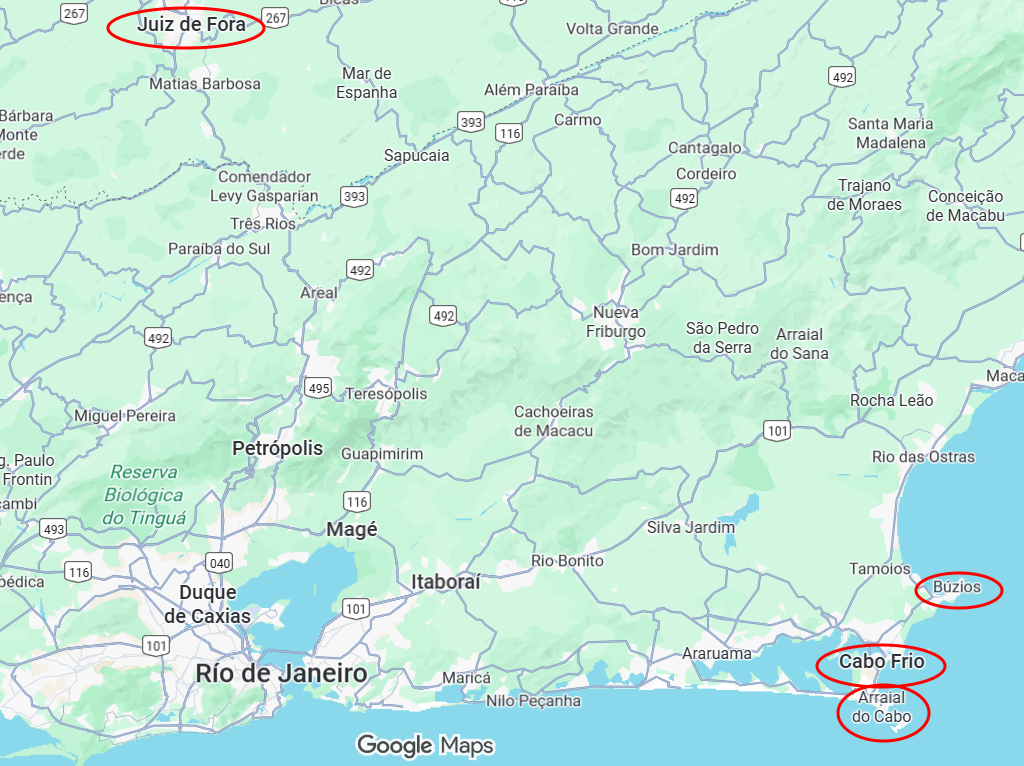
Since Niteroi didn’t work out for us, we needed a plan B, namely driving north to Cabo Frio and camping there. We had a horrible day on the road with tons of (unmarked and camouflaged) speed bumps, narrow and busy lanes, hot weather, and three potential camp spots that didn’t work out, because of new rules against campers or the wind being too strong, whipping up seawater.
(As always, hover over or click on photos in galleries to read their captions.)
Can you see the speedbump we missed?
Big trucks on narrow lanes
São Pedro da Aldeia
Eventually, we settled in a quiet waterfront suburb of São Pedro da Aldeia, on the south side of the giant saltwater lagoon. The wind was less strong, the people were friendly, and our backyard was grassy with palm trees and nice views.
Our free camp spot in São Pedro da Aldeia
Still windy, but less windy than elsewhere in the area
Cute lighthouse along our walk
Rest spot for the fishermen
Curious cows. Maya wasn’t a fan.
Hot and still day on the lagoon
Resident burrowing owl
Happy hour on our grassy beach along the coast of Brazil
A tropical scene along the salt lagoon
Despite being parked close to the dirt road with through traffic, we enjoyed our stay and walks with Maya and even returned from Cabo Frio once the wind picked up again.
Prominent statue in São Pedro da Aldeia
Interesting name for this pet store in São Pedro da Aldeia
Cabo Frio
Close-up Cabo Frio
We had hoped for a pleasant week of beach camping in Cabo Frio, but it was not meant to be. This area is notorious for its strong winds. The three of us did manage to snatch a few nights and our new Australian friend Larry joined us. We’d seen him in Rio as well, but due to my work assignment we hadn’t had time to hang out with him.
Drone shot of our camping spot in Cabo Frio (Photo courtesy of Larry Tofler)
The beach in Cabo Frio
Beautiful sand and water in Cabo Frio
Bird’s eye view of our camping area in Cabo Frio (Photo courtesy of Larry Tofler)
Sunset in Cabo Frio (Photo courtesy of Larry Tofler)
Sunset over the freshwater pond in Cabo Frio
Maya rinsing off in the freshwater pond
In Cabo Frio, we went for beach walks and a stroll into the dunes. Across from our parking spot was a small freshwater lagoon, which was perfect for doggie rinse-offs after sandy and salty outings. The weather was heating up a lot.
Walking in the dunes with Mark, Maya, and Larry
Good exercise for Maya!
Pretty, soft sand in the dunes
Mark and Larry scaling another dune. It was too hot for Maya and me.
Rest in the shade with my companions
Looking back towards the dunes
One last dune shot
Arraial do Cabo
The four of us (including Maya) organized an Uber from Cabo Frio to the most popular and stunning beach of Arraial do Cabo. Except, the driver could only drop us off 4km away from the praia – only authorized cabs and vehicles were allowed past this point – so we faced a steep, hot, and sweaty walk to cross the hills towards the beach.
Sweaty walk to the beach of Arraial do Cabo (Photo courtesy of Larry Tofler)
Walking towards the main beach of Arraial do Cabo
Once there, a refreshing dip in the icy waters followed for me and Maya, who seemed to be tolerated on leash, despite the information we had read beforehand about dogs not being allowed on the sand and in the water.
As the day progressed, it got really crowded on and off the water.
Maya and Mark check out the cold water
Cooling off in the pretty but icy water of the bay
In our lifestyle, flexibility is key. I’ve often mentioned that Mark and I both work while traveling the world as nomads—a routine we’ve maintained for over 20 years. Usually, as freelancers, we have a fluid schedule and can adjust our work around the demands and challenges of daily life. But every couple of years, a massive translation project lands in my inbox, forcing us to make solid changes to our plans in exchange for a welcome chunk of income. That’s exactly how we ended up in Rio de Janeiro earlier than planned.
(As always, click on or hover over photos in galleries to read their captions.)
Rio de Janeiro in South America
Rio de Janeiro in Brazil
Rio de Janeiro, the city
When Mark returned from his three-week annual visit to the US at the end of July (while Maya and I held down the fort at a campground), we were eager to meander along Brazil’s famously beautiful coastline, wild camping along the way. That plan lasted two weeks—until the translation assignment arrived. Soon enough, we were parked in the driveway of Fritz House, the property of a Brazilian man of German descent who welcomes overlanders for a fee. His setup included WiFi, water, electricity, toilets, and showers.
Entrance to Fritz House
Not the nicest of campgrounds
The toilet and shower blocks were located down the driveway
This level was the nicest one on the hillside property
View from the “main level” of the campground
The bathroom blocks on the nice and grassy level – only the women’s had a hot shower
Orchid-like flowers on the property
Since I had already started the two-week project en route, we ended up staying 11 nights at Fritz House. I worked full-time while Mark tackled camper projects like repainting our ladder and four electric jacks. We also did laundry that had to line-dry and cleaned the water tanks with bleach.
Mark removes all four jacks
Priming and painting the smaller parts of the ladder
Priming and painting the four electric jacks and the camper ladder
Back to work: spray painting the camper ladder
Freshly painted camper jacks with a new, black touch at the bottom
First Glimpse of Rio
During our stay, we hitched a ride with a tour guide friend for our first look at Rio’s famous beaches. To our pleasant surprise, dogs were welcome. We started at the “fancier” Ipanema Beach, framed by an impressive rock on one side (which technically overlooks Leblon Beach) and a scenic peninsula on the other, where we stumbled upon a professional photo shoot.
Ipanema Beach with the prominent Dois Irmaos rock in the distance
In Part 1, we shared our first impressions of Paraguay and explored its historic Jesuit missions. Now, our journey continues with reunions, big cities, muddy roads, and a deeper look at life in this underrated country.
Southern Paraguay contains most of the country’s attractions.
Paraguay in South America
Map Overview Paraguay
Back to Encarnación: Reunion Time
On May 19th, we reunited with our American friends Duwan and Greg from Make Like An Apeman, who’d just finished backpacking South America for a year. They had booked two Airbnbs — one in Encarnación, the other near Areguá, an hour from the capital — and invited us to stay.
(As always, hover over or click on photos in galleries to read their captions.)
Our first apartment and its small yard
Using the car as transportation device
Doing heaps of laundry
Yay! The Airbnb has a washing machine!
We quickly separated the camper from the truck, parked on a concrete pad, and shut down our fridge to enjoy house life for a change. The next few days were cozy and productive: we took turns cooking dinners, I did heaps of laundry in the available machine, Mark and I ran errands and caught up on work, and our group explored the city and waterfront with Maya.
Stack near the waterfront
Walking along the river with our friends
Happy hour at the beach bar in Encarnacion, Paraguay
We also followed a boardwalk to the colorful city “letters” and strolled past Encarnación’s cathedral and central plaza.
Sunset over “the letters” of Encarnación
The cathedral of Encarnación
Sapucai: An Old Train Yard
As our friends stayed behind for another night, we hit the road towards Asunción, because we required two days of driving to reach the capital area. We stopped in Sapucai, known for its old train yard.
Potholed roads of Paraguay
Old train in Supacay
Camped for the night in Supacay
Sapucay along the old railroad tracks
Unfortunately, the train museum closed earlier than indicated (we managed to visit in the morning), our fresh water tank ran dry (so we struggled with the little bit of drinking water we had left), and loud traffic and fireworks made sleep impossible (we should be getting used to this.)
Visit to the railroad workshop
The old railyard is now a museum
Old train engine
Part of the museum: old office equipment
Railway museum
A walk on the grounds of the museum
Still, we walked Maya on a bike path and tried to stay flexible, adjusting our plans due to impending rain and muddy red dirt roads.
This cat stayed with us the entire time.
The railway bed is now a walking and biking trail
Persistent cat
Yaguarón: The Wooden Church
Before reaching the capital region, we visited Templo de San Buenaventura in Yaguarón, known for its ornate wooden interior. A local guide explained the church’s intricate design for a tip.
The interesting church of Yaguarón
Interior of the church
Intricate altar
View from the interior of the church towards the outside
The old bell tower with the antique bell in the foreground
Paraguay is a country often skipped by overlanders and tourists alike. With no world-famous attractions and sandwiched between popular Brazil and Argentina, it remains overlooked. But after traveling through increasingly expensive countries, Mark and I were more than ready for a change. Paraguay promised affordability, authenticity, and, according to our friends — sushi!
Southern Paraguay contains most of the country’s attractions.
Paraguay in South America
Map Overview Paraguay
Encarnación: Entering Paraguay
We crossed into Encarnación on May 11th without any issues — unless you count Mark knocking over the customs officer’s mate cup. That moment confirmed a fun fact: in Paraguay, mate is served cold, unlike in Argentina. Another surprise? The now soaked and hand-written vehicle permit had to be recreated.
(As always, hover over or click on photos in galleries to read their captions.)
Crossing the international bridge between Posadas, Argentina and Encarnacion, Paraguay
Welcome to Paraguay!
Filling out the car permit for a second time
Paraguayan license plate
The city gave us a place to run long-delayed errands, save on gas prices, and visit a grocery store that had many items we couldn’t find or afford for a year. We loaded up, grabbed BBQ from a Sunday street stand, and sat by the river feeling like we’d finally entered another budget-travel paradise.
Our first meal in Paraguay is take-out asado
A friendly face and friendly prices at the gas station
Well-stocked grocery store Super Seis
Celebrating our arrival with a drink
Our first (free) boondocking spot in Paraguay
Sunset over the river
But reality hit that night: loud motorcycles, thumping music, and little chance of sleep reminded us that we were still very much in Latin America.
Waterfront boardwalk
The main beach in Encarnacion
Old warehouse
Old silo
Lifeguard station on the main beach
A pretty river beach in Encarnacion
Beach sign with the skyline of Posadas in Argentina in the background
Life on the Waterfront (and a Sushi Dream)
Knowing Paraguay would be cheaper than Argentina or Chile, we’d saved up chores and repairs. In Encarnación, we tackled a camper ladder repaint, installed a mirror, and found transmission parts — choosing to do the work ourselves to save $400 in labor. The waterfront became our “work station.”
A new mirror
Picking up and installing our freshly painted ladder
Despite the chaos, one night stood out: Mark and I finally went out for cocktails and indulged in a sushi boat at Hiroshima, a Japanese restaurant. We hadn’t felt that luxurious in years.
Warning: This is a long post, heavy on photographs.
Mark, Maya, and I entered Uruguay from Argentina without expectations. We knew the coast drew lots of people, Montevideo was the capital, and Colonia del Sacramento was a highlight and UNESCO World Heritage Site. And that the country was super expensive, aptly called the Switzerland of South America.
(As always, hover over or click on photos in galleries to read their captions.)
Uruguay in South America
The country of Uruguay and our sights
Uruguayan flag
Uruguayan license plate
Dealing with the border formalities was a bit confusing (everyone from either side wanted to inspect our camper) but didn’t take too long. We were a tad nervous regarding the “prohibited items” we brought to sustain ourselves and our dog (check the blue sign and guess what we carried), but Maya’s paperwork was in order, which proved important – and distracting – enough.
Walking to the border offices to deal with all the paperwork
Ready for a new country in Thirsty Bella
How many of these items did we have in our camper?
Salto Grande Dam
Right across the border, on the outskirts of Salto, we stopped by the Salto Grande dam, operated by both countries. There, Mark and I partook in a free tour, conducted in Spanish.
The massive turbines
Viewpoint over the dam
Salto Grande Dam, seen from Argentina
One of the massive doors that regulate the water flow
Driving back from Argentina to Uruguay on the tour bus – we did this two hours earlier in our camper; the dam is the border crossing in Salto.
Afterwards, mid-afternoon, we decided to put some miles behind our wheels, since we hoped to cross the entire country and reach the coast within a few days. In Uruguay, we planned our route and stops more carefully, due to the costs. When gasoline has a price tag of $7 a gallon (about $2 per liter), you think twice about detours and their “worth.”
Our first camping spot for the night was a bit overgrown, but hidden from the road!
Our second night was spent in a free campground that was flooded.
Our third free camping spot necessitated driving under this low bridge; we just fit!
The end of this turnaround point was the only spot with open sky and sunshine, needed for Starlink, solar power, and an anxious dog.
We stopped at a small clearing in the bushes, out of view, for that first night. The next three days, we leisurely traversed the hinterland of Uruguay, gazing at the well-kept homes and fields and feeling happy for the livestock – mostly horses, cows, and sheep – with all that juicy, bright-green grass everywhere!
Happy cows in Uruguay
Lush and pretty fields
We also came across a dinosaur display, with preserved footprints and information signs.
Signs with info in Spanish
Dinosaur track on display
Old footprints!
The people we met along the way were friendly, we enjoyed this peek into lesser-known territory, and we happily noticed the lack of garbage everywhere, but we were surprised at the state of the throughways.
Filled potholes; one can wonder if it’s better or worse to hit these piles of fresh asphalt.
One of the gravel roads
Maya doesn’t like dirt roads and holds on for dear life.
Broken road surfaces
We would not fit on this bridge with our camper.
Old car from a local driver
Thinking that Uruguay was a relatively developed nation with a relatively western mentality, we had counted on beautifully paved main roads everywhere. Not in the back country. For at least 100 of the 400 miles across, we dealt with broken pavement, potholes, road work, or dirt tracks going east-west. The north-south equivalents seemed in better shape.
La Coronilla
The Atlantic coast brought pleasant surprises. First, we arrived at La Coronilla at the exact same time a familiar-looking kombi VW bus did. Mark recognized them as the Kombi Chronicles, a British couple with two cats, who had been exploring Latin America overland for a few years. We knew Willow and Lee through Facebook, WhatsApp groups, and mutual friends. It was great to finally meet! (They have a popular YouTube channel and Facebook page as well.)
Meeting Willow and Lee of the Kombi Chronicles for the first time
The VW bus of our Kombi Chronicles friends, parked on the bluff
Sunday afternoon with our new friends
After an introductory chat, they decided to stay another day, a Sunday, on which we hung out all afternoon and evening, chatting, exchanging stories, and sharing popcorn and wine. It’s always nice to meet like-minded folks and we hope to run into them again soon, on the way to – or in – Patagonia.
Our camping spot in La Coronilla; away from the parking area
Maya is much happier on the bed than in the car, these days.
Our boondocking spot offered an “exotic” setting under palm trees, long walks on the beach, a decent view, and the sound of waves when falling asleep. It was quiet at night, so all three of us could rest up.
First beach walk with Maya in a long time!
One of many dead penguins along the Atlantic beaches
Roaming About – Liesbet Collaert & Mark Kilty & Maya
We have been perpetual nomads as RVers, sailors, house and pet sitters, and overlanders since 2003. Currently, the three of us are roaming about Western Europe, searching for our next camper.
As lifetime adventurers, we are self-employed and maintain a tight budget. This blog is about all that – and more – to inspire a life less ordinary. Don’t dream but do! 🙂
This Daily Travelogue is a labor of love for our families and friends at home and around the world. Prior to 2020, all our trips were documented on yearly blogs which can be accessed below. THIS WORDPRESS BLOG IS A COPY OF OUR MAIN BLOG WHICH ALSO CAN BE ACCESSED BELOW. Be safe, stay healthy, and stay connected.