From Órgiva in Andalusia, Spain, it took a full day of driving – and topping up with expensive fuel thanks to the newly created war – in our rental car to reach the final two Portuguese destinations of our Southern Iberian Peninsula trip.
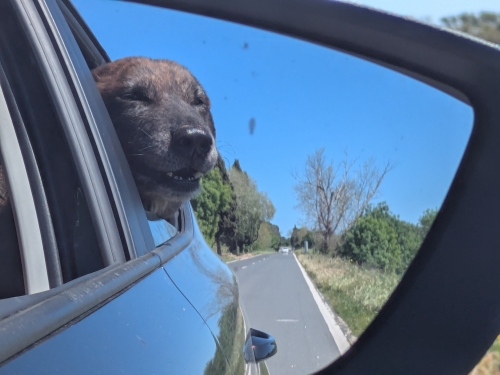
Sniffing the air in the Portuguese countryside
It was the middle of March by then. We had a five-night gap between two-week rentals and, since I wanted to explore the Algarve a bit more, I had booked a short stay in São Teotónio, in Portugal’s Alentejo region. Sleeping in the actual Algarve province was cost prohibitive for us.


São Teotónio and the West Coast
The only nice day in the forecast was the day after we arrived, a Monday. An online friend of mine – fellow memoir author and successful artist Alison Sheldrake – lived in nearby Aljezur and we agreed to meet for lunch that day in Odemira, only a ten-minute drive north of us.
To fully take advantage of the sunshine that day, Mark, Maya, and I set out on a coastal walk in the morning, which might not have been the best idea as we showed up to our date sweaty and exhausted!
(As always, hover over or click on photos in galleries to read their captions.)


Nevertheless, it was a great opportunity to check out two pretty beaches that are part of the famous Fisherman’s Trail. One even had a waterfall!


For a couple of hours, we enjoyed local food and getting to know Alison and her husband, Dave, better. Their rescue dog, Zara, and ours, Maya, got along just fine. Well, both pretty much ignored each other after the initial introduction. It was a lovely time.


Rain was predicted for the following afternoon. Once again, we tried to make the best of the weather before that happened by driving farther north and focusing on exploring the coast and another section of the Fisherman’s Trail.
We started at Furnas Beach, which sported a wide stretch of sand and the mouth of the Mira River. Curious about the town across the river, we made the 20-minute detour into Vila Nova de Milfontes to check it out.


Then, we followed a dirt road for a while to gaze over a cliff and cove before reaching Cavaleiro Beach. We didn’t feel energetic enough to climb down to the actual sand and then back up again.


Instead, we continued our drive to the lighthouse to eat our sandwich lunch on the boardwalk and check out popular Cabo Sardão while backpacking hikers continuously passed by.


By the time we reached the cute village of Zambujeira do Mar, threatening clouds had gathered. We stubbornly walked through town and along the cliff trail before running back to the car as the first fat raindrops appeared.


The weather remained crappy for the rest of our stay in the area. We dealt with research, searching for a 4×4 Vario van, travel logistics, future bookings in France, and job and writing tasks for me. In between storms, we walked into the center of São Teotónio for groceries.


Ironically, our shortest stay during these 2.5 months in southern Europe turned out to be the most pleasant regarding accommodation. This small rental house – for once – had everything we needed, including modern appliances. Unfortunately, the weather wasn’t nice enough to sit outside on the patio.


The Western Algarve
Our last day arrived and we still hadn’t made it back to the Algarve. So, we risked it. We packed our lunches and drove an hour and a half south to Lagos to check out a few beaches under dark-grey skies. It was busier than expected!
What we found was a network of boardwalks connecting different bays, beaches, and coves. We hadn’t expected this infrastructure. Thinking we’d have to drive and park at separate highlights, we hadn’t brought drinking water or food. Still, we couldn’t resist following the wooden trail from beginning to end.


Our next stop was Praia da Luz, where it turned really windy and chilly. After a quick lunch on a bench and a stroll, we considered the sky and the time.


We decided to satisfy our curiosity about Sagres, in the extreme southwest corner of Portugal, adding a 40-minute detour to our itinerary. I don’t know what I expected from this seaside town, but it didn’t really do it for us.


After checking out a fishing port and a surfer’s beach, we reached the most popular spot in Sagres: a fort with a hidden lighthouse behind it. The attraction was super expensive and under construction, so we just walked by and checked out a busy overnight spot for overlanders instead. Why? Because it contained four (!) different Vario vans. As we are looking for one, it would have been nice to chat with a Vario owner. None were 4×4, though.


Castro da Cola
On our drive north to the final two-week rental of our trip, we stopped in Castro da Cola, where we found an old church and the remnants of a fort. Being the only tourists around, we enjoyed the ruins, the views, and a frisky, off-leash Maya.


Cuba
Our last two-week stay, also in Portugal’s Alentejo region, was supposed to be the quietest one. Right. I think you can already guess that wasn’t the case.
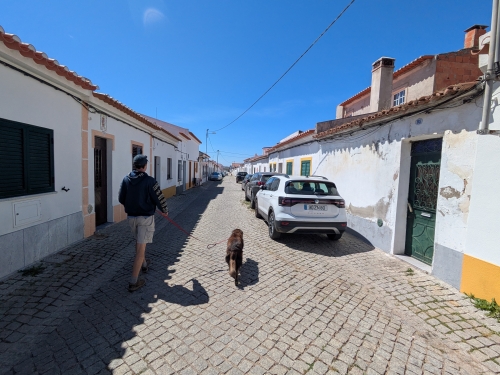
Our street in the village of Cuba
We arrived to a kitchen counter covered in wood dust and ants. The owner couldn’t send anyone over because it was Sunday. Luckily, the local grocery store was open (unlike in Spain on Sundays) and we could buy ant spray. This created an even messier – and more poisonous – environment.


That week revolved around spraying the wall and cleaning the counter three times a day and not being able to prep meals out of fear that poisoned ants would fall into our cooking pots and food. Or onto the floor, where Maya would vacuum up crumbs and food droppings. Even after the owner came over, sprayed the ceiling with strong chemicals, and covered the area in plastic, ants and larvae kept falling “through the cracks.” It was gross, but the casualties slowed down over time.


Cuba itself was cute enough and we enjoyed the typical Portuguese buildings, white with colorful stripes along the bottoms of the facades and around the windows.


On our first walk, we discovered a dog-racing event. Initially appalled, annoyed, and mad at the scene, we decided to give it a chance and watched a few races as the only spectators. Taking it all in, we realized this was a low-key hobby of greyhound owners who seemed to treat their dogs well.


Beja
Our first day trip was to nearby Beja. Checking out the small castle in the middle of the city was nice, especially since Maya was allowed on the grounds, but the employees were unfriendly.


Lunch out was a better experience after two failed attempts. We ordered typical Portuguese dishes – duck rice for Mark and fish balls with rice and beans for me – which we washed down with a liter of homemade sangria. If that didn’t lift the spirits, nothing would.


We strolled through the rest of town, which contained a few historic buildings, before returning to our ant mess at home. The little patio out back offered some relief, but the lingering sewage smell chased us inside at some point every day.


More Cuba
This rental house stood in stark contrast to the previous one and we weren’t too happy. In addition to the ant infestation, the house lacked comfort, the walls were thin, and the neighbors noisy. But the biggest disturbance to our sleep came from the cobblestone street out front. It wasn’t busy per se, but the bakery across from us attracted people day and night, creating constant traffic and youths demanding bread at all hours – even overnight when the bread was being baked. But maybe this was just a Semana Santa (Easter Week) thing?


After a few days, the weather finally turned around and we enjoyed gorgeous sunshine. When we weren’t sightseeing, we strolled to the store for groceries or to the nearby park for walks and a rest on the grass.


Our Airbnb listing in Cuba showcased photos of a beautiful lake with white-sand beaches. Reality offered a rather unremarkable reservoir with a run-down stretch of sand. The highlight turned out to be a 4.5-mile walk through the surrounding fields, where we were the only human beings – and dog – around.


One afternoon, we decided to explore our “backyard.” After dealing with a handful of barking loose dogs (I swear Portugal has a lot of similarities with South America), we walked through the fields to visit a couple of windmill ruins.


The following day, we ventured farther afield and accidentally ended up on a private farm, forcing us to backtrack for a mile. Maya didn’t mind and had a great time in the swampy grass, returning home soaking wet. When we later found tons of ticks on her, that part of town became off-limits.


Vidigueira
At the end of March, we finally made the short drive to Vidigueira, famous for its wine and the explorer Vasco da Gama, who was named its 1st Count. The town itself wasn’t particularly special, but we enjoyed our stroll. The idea had been to eat a typical Alentejo lunch in the village of Vila de Frades on the way back, but without a reservation on a Saturday, we didn’t stand a chance.


Vila de Frades
Days later, we returned to explore more of this cute village and try again at the restaurant. This time, we couldn’t eat there because dogs weren’t allowed. Luckily, we had a backup plan of packed lunches!


When returning from Monsaraz (see underneath), we planned a visit to a Roman villa near Vila de Frades. We waited around until it reopened after lunch only to be “greeted” by the loose, aggressive, barking dog of an employee.
This was one of the few dog-friendly sites in the area, so this kind of welcome was frustrating and off-putting. Why don’t people train their dogs better or at least keep them away from other dogs when they’re this nasty? Mark was super annoyed and principled, so I did a solo visit by myself.


Évora
Évora – which I would call one of the highlights of Portugal – was an anticipated destination an hour’s drive from Cuba. I had planned a 2.5-hour walking tour that brought us past nice buildings, parks, and squares.


The main attraction in this historic city is the Chapel of Bones, which had been my main reason for visiting. Mark didn’t want to spend 7 euros staring at human bones and skulls, so he stayed outside with Maya.
Other cool sites included the Roman temple ruins, the amazing aqueduct, and the city walls.


Again, we attempted a typical (and fancy) Alentejo lunch at a recommended high-end restaurant. I had really looked forward to this one. Again, we were turned away because of Maya. We saved a lot of money that day by eating ramen noodles – with a cheer-up drink – at an Asian restaurant instead.


In the afternoon, a country drive brought us to a menhir and a megalithic site. At 7,000 years old, this circle of rocks is older than Stonehenge.


Monsaraz
As often happens, our favorite destination turned out to be the unexpected one: Monsaraz, a medieval walled town. What a place and what a setting! This small enclave offers expansive views over the reservoir and countryside while maintaining a picture-perfect interior that’s also clean and cute.


Its well-maintained castle (free) is the highlight, as is the fact that not too many tourists flood the area since Monsaraz lies off the beaten path.
We left feeling like we had found the quintessential medieval village.


Since we were almost leaving the area, we made three (!) attempts in Cuba that evening to enjoy an Alentejo meal out. We failed miserably and ended up cooking at home.
Our last day in Cuba
Good Friday arrived… our last day in the village of Cuba. We were determined to eat a typical Alentejo lunch and returned to our first choice, Adega da Lua. They had promised us ahead of time that Maya would be allowed inside, but… the restaurant was full and we didn’t have a reservation.
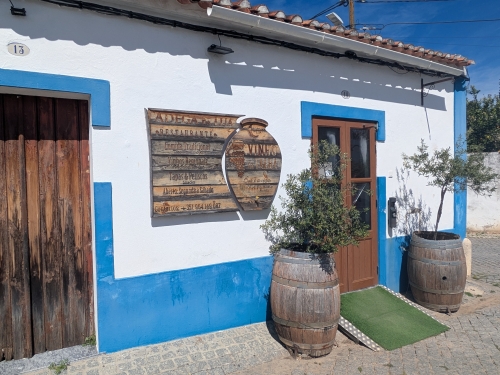
A typical Alentejo restaurant in Cuba – We never managed to eat here.
For kicks and giggles, we walked by Essa Taberna, another highly rated local restaurant, which Google had marked as “closed.” And that’s when our bad fortune turned around. Owner Paulo welcomed us with open arms. He was there because it was a holiday (he has a day job as well) and to prep for dinner service.


He produced an Alentejo feast of multiple dishes – like a tasting menu – but without meat since it was Good Friday. Small, tasty dish after small, tasty dish appeared from the kitchen and the wine he left on our table flowed smoothly.


After the dessert surprise, he joined us outside, another bottle of his favorite white wine in hand, and kept our glasses and bellies filled – on the house – while chatting away. Unexpectedly, this extensive lunch became our highlight of Cuba, where the hospitality and local charm had finally grabbed us.
Paulo told us Christopher Columbus had been born in his town. This surprised us, so we followed the “evidence trail” that afternoon. Despite being a tad tipsy, we don’t think this alternate truth is correct.


And then the slightly dreaded April 4th arrived. On that day, we had to return our long-term rental car, and the adventure with Maya and all our luggage would continue… by train. Stay tuned!
Expenses for March 2026
Not unexpectedly, March was a pricey month, mostly because of lodging in Portugal and our upcoming accommodation costs in France. We also had an unexpected $129 expense to help out the new owners of Thirsty Bella, who got into trouble in Chile.
Another big bag of Maya’s dog food – to be delivered in Belgium – was purchased, but the other categories were manageable. We used gift money from my parents for most of our meals out.
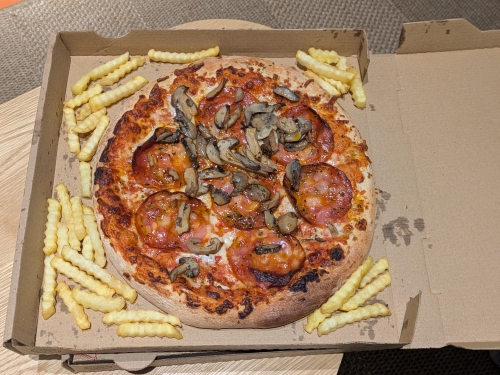
Take-out pizza – and fries in Cuba
Out of the $2,825 total, only $1,000 went to actual living costs. If only we didn’t have to rent places to sleep! 🙂
Here is the breakdown:
- Accommodation: $1,830
- Groceries: $312
- Dining out: $236
- Car: $148 ($140 fuel; $8 parking)
- Miscellaneous: $129 (apostille and notary document Chile)
- Dog: $94 ($76 food; $18 meds)
- Utilities: $33 ($17 propane; $16 internet)
- Alcohol: $33
- Transportation: $24 (train Lisbon to Porto for Maya)
- Entertainment: $7 (puppet show, tourist train, Sentinel House)
- Drinking out: $5
- Laundry: $5
- Household supplies: $2 (masking tape)
TOTAL: $2,825
Next up: Pretty Porto in Portugal
Donate to Roaming About to help maintain this website:
Curious about a previous ten-year chapter in our nomadic lives, which includes eight years aboard a 35-foot sailboat in the tropics with dogs? Check out my compelling, inspiring, and refreshingly honest travel memoir:

Discover more from Roaming About
Subscribe to get the latest posts sent to your email.





May 10, 2026 at 11:02 am
I am continually impressed how flexible you are about change. I hate change, yet you embrace it. Lovely pictures.