Roaming About

A Life Less Ordinary

Category: Nature (page 1 of 21)

An Introduction to Burgundy in France (And Our April 2026 Expenses)

My cousin, Griet, and her husband, Wim, decided to join us in France for their eleven-day vacation. Of that time, we spent a wonderful week in the Dordogne, and we needed two solid days of driving back to Belgium. For the three nights and two days that were left, we hunkered down in Burgundy. One day was dedicated to more cute villages and the other to natural settings.

Gien-sur-Cure

For this short stay, we opted for a house in a tiny village surrounded by countryside. Despite being located along a main road, it was quiet at night and we managed to keep enjoying the beautiful weather on the patio whenever we were home.

(As always, click on or hover over photos in galleries to see their captions.)

The mattresses hurt everyone’s backs, but the bathroom was modern and the kitchen sufficed. There was an antique washing machine, which, surprisingly enough, Mark and I already had experience with in Argentina. It came in handy as I wanted to wash all our clothes before arriving in Belgium, where we don’t have our own laundry facilities. Of course, the machine broke on our second day, but we lucked out because a neighbor could fix it immediately. The owner of the home lived next door.

Châteauneuf-en-Auxois

This tiny village on a hill oozed medieval charm, attractive buildings, and peace. We felt it was built in a different style than the beauties of the Dordogne, but it was cute nevertheless.

Our small group strolled around Châteauneuf for about an hour, skipping a visit to the picturesque castle. We had a busy day planned.

Continue reading

Exploring the Dordogne in Southern France with Family

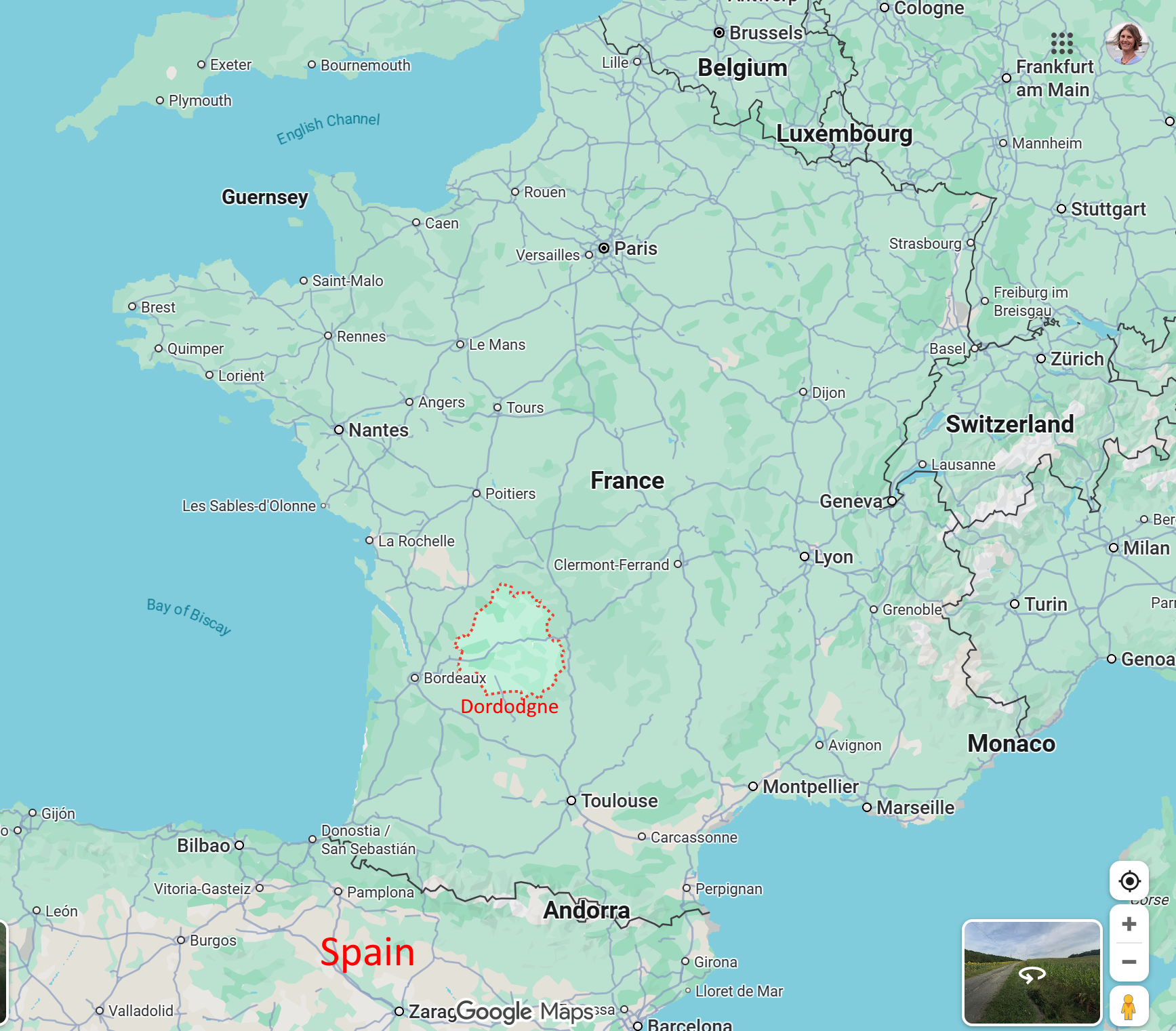
While our week in Libourne was a positive first taste of Southern France, our week in the Dordogne sealed the deal about us really loving this area – and being surprised about that!

The Dordogne region in France

Our perceived notions steered us towards Andalusia, Spain, to gauge it as a potential place to grow roots one day. France had never been on the radar, because we didn’t know much about this country (despite it being next door to Belgium) and encounters with French people around the world hadn’t been pleasant, generally. We obviously should reconsider and look forward to exploring more of France in the future!

Périgueux

But let’s get back to the middle of April, when my cousin, Griet, and her husband, Wim, picked us up at the train station of Périgueux after our one-hour ride with Maya and the luggage. To our surprise – but not theirs – all our belongings fit next to their vacation gear in the magical trunk.

(As always, hover over or click on the photos in galleries to read their caption.)

Since this was the start of our Dordogne travels, we began with a walk through the region’s capital Périgueux itself, hitting some of the highlights and chatting with friendly locals.

We didn’t have a lot of time, but strolled through some of the narrow streets, discovered a nice park, and photographed historic buildings.

Saint-Avit-de-Vialard

The four of us had rented a small mobile home at a campground in Saint-Avit-de-Vialard, which is a popular way to vacation in France. There are a lot of facilities – bathrooms, swimming pools, laundry, a restaurant, and a shop – of which we only used the bakery section in the store.

This is not really our style of accommodation, but when you’re in good company, the place you stay in doesn’t matter so much. Plus, this last cabin on the property was in a great location, far from the entrance and the commotion and next to nature.

We really lucked out with the sunny weather during our time in the Dordogne! We ate every single meal outside on the patio and managed to explore the region in depth and in shorts.

Limeuil

Our first afternoon excursion took place in Limeuil, another picture-perfect historic village. It swiftly became our favorite one in France.

The five of us climbed the hill and strolled through the medieval streets, taking in its beauty and cleanliness. We seemed to be the only tourists around on this weekday, which made the experience extra special.

Continue reading

Andalusia, Part Three – Attractive Villages in Spain’s Granada Province

This is the last blog of three about our six weeks in Andalusia, Spain. The first one covers Ayamonte and Sevilla – and a side trip to Cadiz – while we stayed in El Rompido for two weeks (you can find it here) and the second one focuses on the pretty white villages in Málaga province. Read about them here.

Órgiva

The funky cottage we booked in Órgiva was the accommodation we had looked forward to the most. And while it was indeed super pretty and unique—with a few inconveniences—our fear of being cold in the mountains during the first half of March turned out to be justified. Whenever we were home, we needed either the gas heater or the smoky wood stove on.

(As always, click on or hover over photos in galleries to read their captions.)

The shower was in a separate, unheated building, which made washing up… less than pleasant. Have you ever taken a hot shower with low pressure and felt the water turn cold by the time it reaches your feet? (The opposite is true as well, when you take a cold shower and the water feels lukewarm by the time it gets down.) Add in patches of skin remaining dry from uneven water flow, exposed to chilly air, while you awkwardly turn in circles trying to get clean… That was our daily experience. Going outside to pee in the middle of the night was less uncomfortable.

This place would be amazing on sunny days, or in spring and autumn. One positive of visiting in winter was that the closed windows kept out the constant barking of dogs at night.

This video will give you a great feeling of our special cottage and garden.

Órgiva had been marked on our map as a potential place to live someday. It didn’t take long to cross it off the list. While there are a few cute alleys, the overall vibe felt a bit rough—more struggling hippies and noticeable homelessness than we expected.

On a better day, Mark, Maya, and I went for a long walk along the stream and into the hills. Despite having to take multiple steep detours due to the swollen river, we enjoyed peaceful moments and decent views.

Lanjarón

This neighboring village—also on our list—left a much better impression. It’s relatively small, clean, and less touristy than Órgiva, with beautiful views and great access to hikes into the river canyon.

There are plenty of trails in the surrounding mountains, one of which Mark and Maya explored while I took it easier. During our stroll through town, we came across castle ruins perched on a hill. Of course we had to climb up.

Overall, we didn’t find anything negative about Lanjarón as a potential place to live, but it also didn’t quite make it to the top of our list.

Continue reading

Andalusia, Part Two – White Villages & Other Sights in Spain’s Málaga Province (And Our February 2026 Expenses)

For our second two-week stint in the southern part of the Iberian Peninsula, Mark and I rented a fairly modern apartment in the coastal city of Benalmádena. The main reason for coming to Spain this winter was to check out a few cute Andalusian villages as a potential future base. Ideally, we would have stayed in one of those towns, but higher rents and cooler mountain temperatures in mid-February nudged us towards the Mediterranean coast instead.

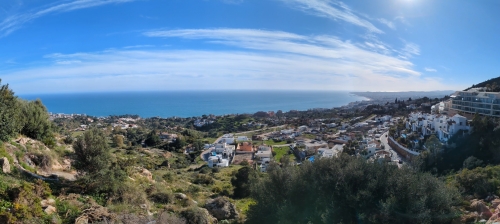
View over the town and the Med from Benalmádena 

The weather improved for a little while, but our apartment lacked outdoor space to enjoy those elusive sunrays during what turned out to be a particularly cold, windy, and wet winter. The thin walls didn’t help either, especially with loud neighbors above us. We relied on the fan for background noise to sleep.

Ronda

The first town we decided to visit was a winner! Mark and I were immediately charmed by the beautiful architecture, narrow cobblestone streets, and spectacular surroundings. We picked a sunny day for our visit and quickly fell in love with Ronda. Yes, it’s touristy—but with good reason.

(As always, click on or hover over photos in galleries to read their captions.)

We admired the historic buildings, three different bridges, and the dramatic El Tajo gorge. While we had planned to descend to the river far below, a couple of hours of strolling around town—combined with a fantastic tapas lunch at dog-friendly El Lechuguita—left us without the energy for that steep descent and climb back up.

Instead, we drove around the outskirts for a better view of what many consider Ronda’s masterpiece: the Puente Nuevo. Completed in 1793, it spans the lush canyon in truly impressive fashion.

Setenil de las Bodegas

Since we still had some daylight left, we made a quick stop in Setenil de las Bodegas—a town I had only recently come across in a blog and that immediately piqued my curiosity.

For an hour, we wandered the shaded streets and photographed the homes built directly into the rocks and cliffs. I found this fascinating, as we never saw anything like it before. The closest comparison we could think of were the cave dwellings of Mesa Verde in Colorado—which, of course, are completely different.

Continue reading

Dipping Our Toes into the (Eastern) Algarve of Portugal

The Travel Plan

During our last three weeks in South America in December, Mark and I needed a “What’s Next?” plan. We had just sold our truck camper in Chile and were officially homeless. Finding our next campervan would likely take a while — we’re very picky. (If you have a Mercedes Vario 4×4 for sale or know someone who does, please let us know!)

After more than two decades as nomads, we don’t really have a home base. Mark’s niece and her husband moved into “our” room above the garage at his mom’s house in Massachusetts, which is a win-win for everyone involved. Living in “our” guest bedroom with a shared bathroom in the middle of a New England winter would only work for about a month. So where could we go after that?

Renting a place in the Caribbean for a few winter months was too expensive. We didn’t want to go to Belgium yet to stay at my parents’ “little house,” because winter there is cold and rainy — and Mark can only stay in my home country 90 days out of every 180. It made more sense to use those days closer to summer. And we were ready to leave South America and its Hispanic culture.

Then an opportunity appeared. A friend invited us to stay at her rented house in southern Spain for a couple of weeks. My parents would also be nearby for their winter break. Add our curiosity about Andalusian villages and the discovery that Mark, as my spouse, didn’t have to do the Schengen shuffle while traveling with me — and the southern Iberian Peninsula became the obvious destination.

Yes, the irony of going from Hispanic South America to Hispanic Spain isn’t lost on me. There are plenty of similarities, but luckily some differences too. 🙂

We started in Lisbon, Portugal, mainly because rental cars were much cheaper there than in Spain, and we could take a direct flight from Boston with Maya. Our plan was to stay in the region for two months and then slowly make our way to Belgium – by train! – in early April. That would be the real adventure of this trip.

The Blogging Plan

This year, I had hoped to publish simple monthly wrap-ups. But honestly, we are doing and seeing so much — way more than we did in South America — that those posts would become ridiculously long.

Writing chronologically and geographically is tricky as well. During our first two weeks in Spain, we actually spent more time in Portugal. So I’m splitting that period into two blog posts: one highlighting our visits in Portugal, and the second focusing on southern Spain.

The Algarve — Part One

Faro

On February 1st, we brought the rainy and windy weather with us from Lisbon to El Rompido, Spain. After a wet drive without mountain views, we greeted our friend Patti and stayed indoors for the next few days, trying to be warm and dry.

On the first decent day — which turned out sunnier than expected — Mark, Maya, and I drove to Tavira to meet and pick up my parents. It had been a year and a half since we last saw each other in person.

We didn’t need an early start because crossing the border into Portugal meant gaining an hour. In theory, we would arrive at the same time we left, since the drive itself took about an hour. Of course, that also meant the return trip would take two hours. 🙂

(As always, hover over or click on the photos in the galleries to read their captions.)

Our little family group spent part of the day exploring historic Faro — wandering narrow streets, having lunch on a sunny patio (Maya wasn’t allowed inside), and strolling along sections outside the old city walls.

Tavira

Since we had time left that afternoon, my parents introduced us to Tavira, another beautiful town. As usual, we hadn’t done research beforehand, which meant every corner of the historic center revealed something new and charming.

Continue reading

Our Introduction to Portugal – Four Days in Lisbon and Sintra

When Mark, Maya, and I arrived in Lisbon, Portugal, after a bad experience with the airline company TAP Portugal, there was a lot of talk about “the storm” that had hit the southern Iberian Peninsula on the evening before our arrival and which had caused some of our delays. For the first time, we checked the weather. It didn’t look promising.

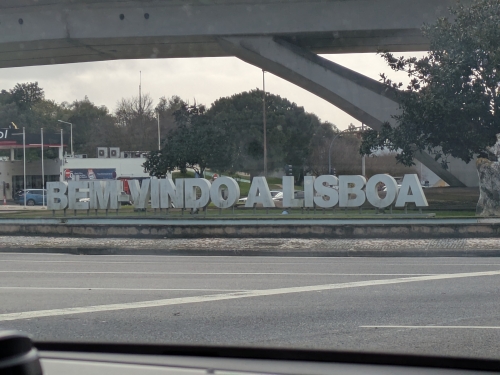
Welcome to Lisbon, Portugal!

There was more rain — and wind — in the forecast, but we would make the best of our four-day stay, despite already missing out on a free taxi ride promised by Booking.com (because we had to postpone our arrival), moving our accommodation out for two days, having less time on the peninsula, and needing to pick up our rental car earlier than expected.

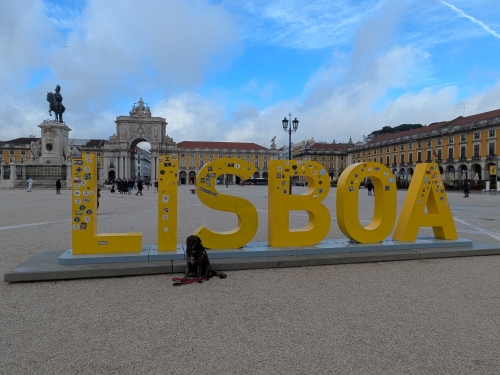
Maya in front of the Lisbon sign

Since we had a six-hour delay (in addition to the two-day delay because of the blizzard in New England), we had to skip our nap upon arrival after a red-eye flight. All these experiences helped with our need for flexibility and resilience. We were not going to complain. Not even about our tiny and moldy, wet apartment, where nothing dried. Because its location in Alfama was perfect. It was our first time in Portugal. And we had finally arrived in Europe!

(As always, hover over or click on the photos in the galleries to read their captions.)

Day one

Since it was noon by the time we checked in, we hit the cobblestone streets after taking a shower and settling in. We decided to try a typical local lunch of grilled sardines and a white fish. For some reason, I’d forgotten that serving entire fish with all the bones — and sometimes intestines — is a thing in Europe. While the flavors were great, I’m a lazy person when it comes to eating. The less work, the better. 🙂

In the afternoon, we explored the cute and mostly pedestrian Alfama neighborhood, climbing its hills, strolling its cobblestone streets, and eating my first of many pastéis de nata. For someone who loves pastries and pudding, this treat is heaven!

Continue reading

Annual Expense Report of a Nomad – 2025 (Argentina, Chile, Paraguay, Brazil, USA)

Expenses - image

Every month, I post a report of our expenses to show that it is possible to live a comfortable, exciting, and adventurous life without breaking the bank. “The less money you spend, the less you need to make” is our motto. 🙂 At the beginning of each year, I produce an expense report for the previous 12 months. This is the most recent one, for 2024.

Our first yearly expense report (2016) can be found here, the report of 2017 is here, the one for 2018 here, our 2019 expenses are located here, our total costs for 2020 are documented here, those for 2021 are detailed here, 2022’s financial summary hides here, you can find our full expense report for 2023 here, and our 2024 costs are recorded here.

These reports include ALL of our expenses, in US$, for two adults and a 60-pound dog. We adopted Maya on June 4th, 2019. Under groceries we incorporate food, produce, and non-alcoholic drinks predominantly bought in supermarkets. Toiletries belong in that category as well. Dining out means eating at a restaurant/event or purchasing take-out food. The health category covers non-prescription medicines and vitamins/supplements; medical contains prescription drugs and doctor’s visits. Because of our income level, Mark and I are eligible for free health care within the state of Massachusetts. For check-ups, we both return to the US East Coast. The internet cost is for our Starlink’s monthly subscription fees. We bought our satellite dish in Lima, Peru, in September 2023.

It truly feels like the year 2025 came and went extremely fast. I still remember it starting at “the end of the world” in Ushuaia, Argentina, and what felt like mere months later, finishing in Massachusetts, USA, after our South American RV journey ended. During that last year, we crisscrossed Argentina, Chile, Paraguay, and southern Brazil, covering many thousands of miles and spending even more thousands of dollars. As a matter of fact, 2025 was our second-most expensive year on record, after 2014 when our life changed due to Mark’s cancer.

As expected, the car category — at $6,000 — was the highest; a trend during those three years on the South American continent. Most of that went to fuel (around $5,000), while the rest was spent on parts, maintenance, tolls, parking, and insurance.

Groceries came in at $4,000, which boils down to $333 a month, which is very manageable. I’m pretty sure we won’t stick to that amount this year in Europe.

Our accommodation cost was higher than in other years, mostly because we spent three weeks in an Airbnb in Santiago de Chile ($800) and I took a 4-night side trip to Easter Island, where I stayed at a hostel ($200). We also “splurged” with a few weeks of real campground stays in Brazil, Paraguay, and Chile.

I have no idea how much other couples spend on dining out. Feel free to enlighten me in the comments. Our total for 2025 was $1,560. Restaurants in South America are generally cheaper than in the US and Europe, so we might have to take a step back in this category. Not that we went wild before.

Under travel ($1,484), we report our plane rides. Last year, Mark flew from Brazil to the US for his annual health check-ups, I hopped on a plane to Easter Island, and we booked two one-way tickets from Santiago, Chile, to Boston, Massachusetts, for the end of the year.

Dog Maya’s expenses hovered around $1,100. The biggest chunk went to vet visits, mostly because of a mysterious pain she developed in her neck in December. This ordeal set us back $500 between the vet in Chile, the one in the US for a consultation, and the drugs she needed. It was the first time in seven years of having her that she needed to see a vet other than for permits and shots.

We also bought dog food for around $400, obtained health permits to travel between Chile and Argentina and then to the US with her for about $150, and bought supplies like treats and toys…

The entertainment category of $800 includes my national park pass for Easter Island and three tours there, our scary rafting trip in southern Chile, a river tour in the Pantanal of Brazil, and entrance fees to other national parks on the continent.

Alcohol came in at $768. Mark and I usually have wine, beer, and a bottle of rum around. Quite a few bottles were purchased to share with friends and at a party on New Year’s Eve.

Our utility cost was $541, mostly for internet via our Starlink antenna. Our business paid for half of the monthly subscriptions, so the service is actually twice as expensive as the $435 I mention underneath. Topping off our propane cost $106 for the year.

Transportation for us means Uber and taxi rides, mostly to get to airports and city centers when camped on the outskirts. The $383 number for 2025 also includes one checked bag fee when Mark brought parts back to Brazil from his US summer visit.

Our miscellaneous category shows $380, of which the most painful part ($220) went to a traffic ticket in Argentina. We also paid money for one mechanical check of a Vario campervan we had planned to purchase in Chile, for an online ad to sell Bella (which brought us our buyers), for Mark’s new driver’s license, and for small souvenirs.

Maintaining and fixing our truck camper cost $227 in 2025, which is negligible in the grand scheme of things.

Mark and I also spent $170 on medical interventions like teeth cleanings (one for him and two for me) in Chile and Brazil and a few medications.

Gifts amounted to $165, which mostly went to the annual photo calendars I create for my family.

The computer category was $157, all for hosting fees to keep this website up and running and for our email accounts.

I think most would agree that our drinking-out category is low at $116 for a year for two people. I bet some of you could spend that on one night out at a bar with friends. 🙂 We usually opt to stay in and drink our own cocktails or organize our own happy hours.

Household supplies came to $103, our annual Chase credit card fee was $95, and we only paid $83 for a year of laundry. Most of our clothes were washed by hand with tap water at campgrounds or river water in nature. When we have the use of a free washing machine (like at our last Airbnb), we go crazy!

Mark owed the Brazilian immigration department $80 for a visa, but this allowed him to stay six months. Belgians don’t need a visa, but I was unable to get an extension after our initial three months in the country, so we had to leave. Should I have entered on my American passport?

And the last and lowest category of 2025 was clothing. Mark bought a pair of jeans on eBay for $28. We really don’t like shopping for clothes and, for some reason, our gear lasts forever. When we purged in Santiago before leaving the continent, I discarded clothes that were easily two decades old. Friends often offer us clothes that they don’t have use for anymore as well.

Speaking of the generosity of others, some of you sent donations in 2025, which took care of our web hosting, a couple of dinners, and a few bottles of wine. Thank you!

The grand total for 2025 comes to a shocking $19,552, a far cry from our usual average of $16,000. Yes, inflation is a thing and we do realize that life only gets more expensive, especially in Europe. We will see what happens this year.

Could you live off $20,000 a year for two adults and a good-sized dog, everything included? Let me know in the comments.

2025 Overview:

Car (fuel: $5,088; maintenance: $700;

tolls: $157; parking: $26; insurance: $22):

Groceries:

Accommodation (Lodging: $998; camping: $570 ):

Dining out:

Travel (plane tickets):

Dog (vet: $488; food: $387; permits: $152; supplies: $83):

Entertainment (national parks, rafting trip, river tour):

Alcohol:

Utilities (internet: $435; propane: $106):

Transportation (Uber, taxis, checked bag fee):

Miscellaneous (fine, car check, ad, license, souvenirs):

Camper (maintenance & repairs):

Medical (teeth cleanings, meds):

Gifts (B-days, Christmas):

Computer (web hosting fees):

Drinking out:

Household:

Bank fees (Chase visa card):

Laundry:

Customs & Immigration (visa Mark):

Clothing:


TOTAL:

Donations:


GRAND TOTAL:


$5,992

$4,015

$1,568

$1,560

$1,484

$1,110

$810

$768

$541

$383

$380

$227

$170

$165

$157

$116

$103

$95

$83

$81

$28

———

$ 19,836

– $ 284

———

$ 19,552

(It might be easier to read the table when turning your device in the horizontal position.)

And that’s a wrap! If you are enjoying these posts and would like to help out with our expenses to maintain this blog, please click on the donate button underneath, in the side bar, or in the menu bar on top. I promise Roaming About will remain an ad-free website. Thank you!

Find all our expense reports here. To learn what other full-time nomads spend each month, check out the blogs of our vanlife friends Duwan and Greg at Make Like An Ape Man.

Next up: A month long winter visit to the States

Donate to Roaming About to help maintain this website.

Returning to Paraguay – The Interlude

This is more of a status update than an exciting blog post…

When we discovered that I couldn’t get a 90-day extension to stay the full six months in Brazil as a Belgian—hoping we’d sell our camper by then—we needed a new plan. The closest border was Paraguay. Having great memories from our previous visit, we decided to make it our South American base for a while, at least until the heat chased us off or a buyer popped up for Bella.

(As always, click on or hover over photos in galleries to read their captions.)

Tacuru Pucu, Hernandarias

After crossing the border in hectic Ciudad del Este on September 11, Mark, Maya, and I returned to the free Tacuru Pucu campground, managed by the Itaipu Dam organization. Just like five months earlier, we stayed the allowed 14 days, but the grounds and facilities had deteriorated further.

Some of the electricity and water hookups were broken, the WiFi worked intermittently, and none of the hot showers functioned anymore. Most days, it was hot enough to shower with cold water anyway—or we could use our own shower and refill the tank with potable water. Maya was only allowed in a restricted area, so long walks were out of the question.

Despite the bugs and the heat, we enjoyed a much-needed break. Our favorite amenity remained the covered palapa, where we could do hand laundry, eat at the picnic table, chat with new and familiar faces (including Larry, who stopped by briefly), and swing in our hammock. I even started reading a book again!

Those two weeks filled up fast with cleaning nearly everything in and on the camper, cooking delicious meals, writing, catching up on Brazil blog posts, and setting up a new computer after more files got corrupted on my ancient laptop. Now, I’m getting used to two new-to-me devices.

I also gave my published book some long-overdue attention and started experimenting with a virtual audiobook. After a few chapters, I abandoned the idea—Amazon’s beta version wasn’t ready for prime time. Meanwhile, Mark repaired our water pump after an entertaining ride to the free zone with a Colombian, a Cuban, and a Paraguayan.

Nights were restless. Each blistering, humid day seemed to culminate in a violent storm, leaving us with a couple of chilly mornings before the heat built again. Maya was terrified of the thunder and lightning, and fireworks or gunfire from a nearby military base didn’t help either.

Mark was sick for a few days as well; a bummer. When it was too hot to do anything but sit in the shade of our palapa, we fantasized and talked about the next chapter in our lives, after our camper sells.

Ñacunday Falls

On our way to Hohenau to revisit Manantial Campground, we stopped for a night at Ñacunday Falls. Reaching the campsite deep in the jungle required trimming branches, brushing past foliage, and careful maneuvering to get level, but the peace was worth it.

Continue reading

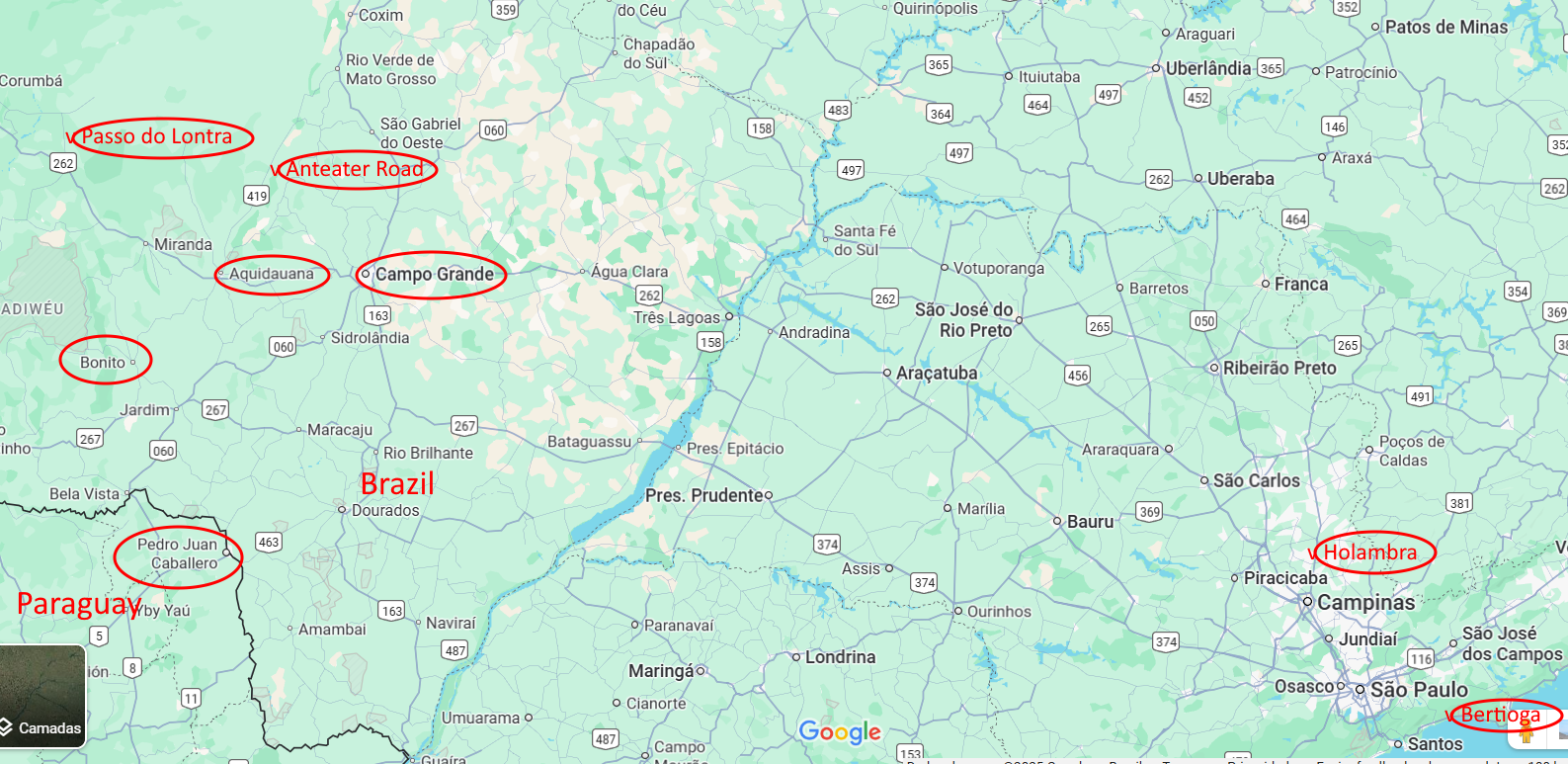
Bonito and the Southern Pantanal in Brazil – Water & Wildlife

Instead of staying in Brazil after visiting Iguaçu Falls and driving north from there, Mark and I decided to return to Paraguay en route to our next destination, for three reasons: fuel is cheaper in Paraguay, so we wanted to cover a bunch of distance in that country; we didn’t want to use some of our precious, three-month entry allowance for Brazil just driving; and we preferred more time in Paraguay, since we’d enjoyed it. I wrote about those last Paraguayan days here.

Our Brazilian route

Border Crossing into Brazil

On June 17th, we left Paraguay and crossed into Brazil again, needing to drive all over town to find the required government offices and paperwork. This was a very different method from our usual border crossings, where the buildings and desks are located along the main highway. But we got everything straightened out and found a great and affordable grocery store with new products.

(As always, hover over or click on photos in galleries to read their captions.)

Bonito

That first night was spent at a loud truck stop near Bonito, confirming the fact that Brazil – especially the inland areas – is very heavy on truck traffic. The rutted condition of the roads, bumper-to-bumper traffic in cities, the actual percentage of these massive beasts in relation to cars, and the number of gas stations/truck stops with truckers’ facilities all contributed to this reality.

I had looked forward to snorkeling activities and scenic excursions in Bonito for many years (my blogging friend Gilda wrote an extensive post about it), but a few elements were against us. Prices were sky high (but we did say we’d commit to one excursion); we happened to be there on a long holiday weekend, which increased those steep prices by another 25%; and rainy/chilly days were ahead.

Before making any decisions about which company and which excursion to book, we walked Maya along one of the clear rivers, noticed we were close to an attractive-sounding campground, and checked this place out. Not only did we love the grounds, we also spotted our new South African friends Jo and Wayne.

The decision was made to move into the campground on that rare hot and sunny day and enjoy the facilities. The price for camping was steep for us, but the employees let us stay the following day until dark without charging extra, so it was well worth it!

Continue reading

Spectacular Iguaçu/Iguazu Falls in Brazil & Argentina

Truth be told, I didn’t know anything about these gigantic waterfalls before arriving on the South American continent, which is strange, since they belong in the same category as majestic Victoria Falls and Niagara Falls. Like me, you’ve probably heard of those natural wonders. Yet, Eleanor Roosevelt is known to utter the words “Poor Niagara!” when she first saw Iguazu Falls. 🙂

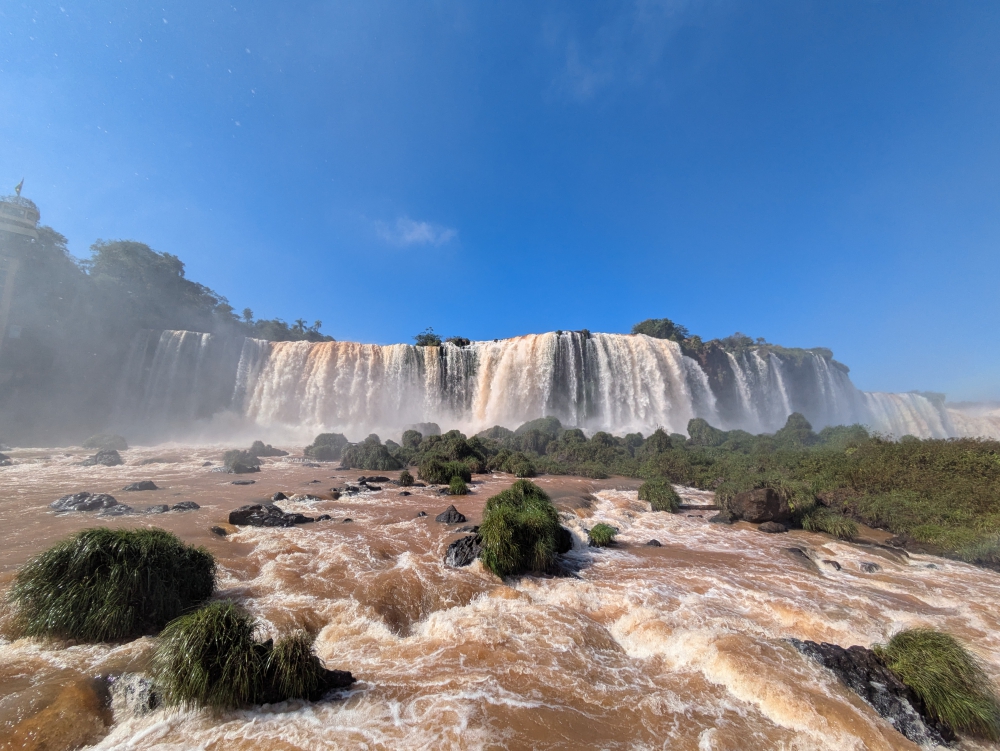
Following a boardwalk on the lowest level in Brazil

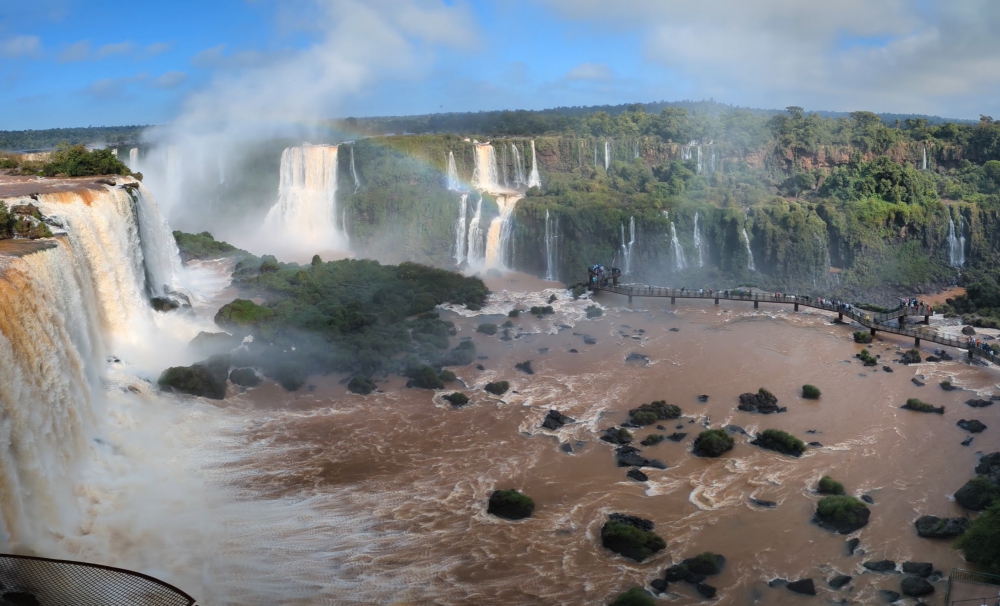
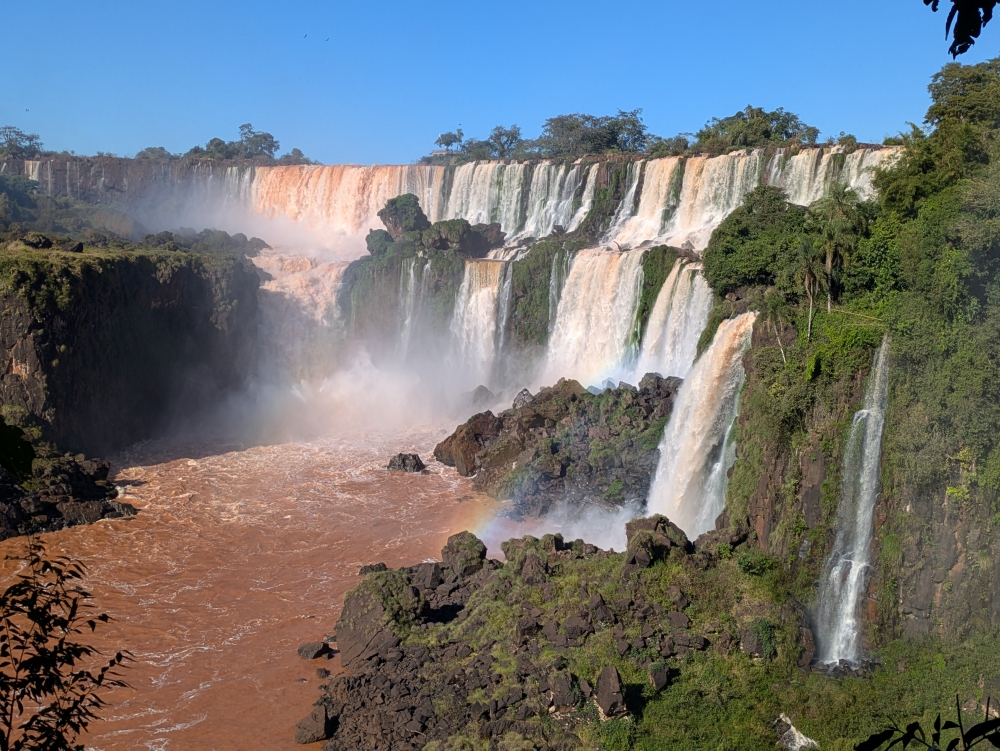
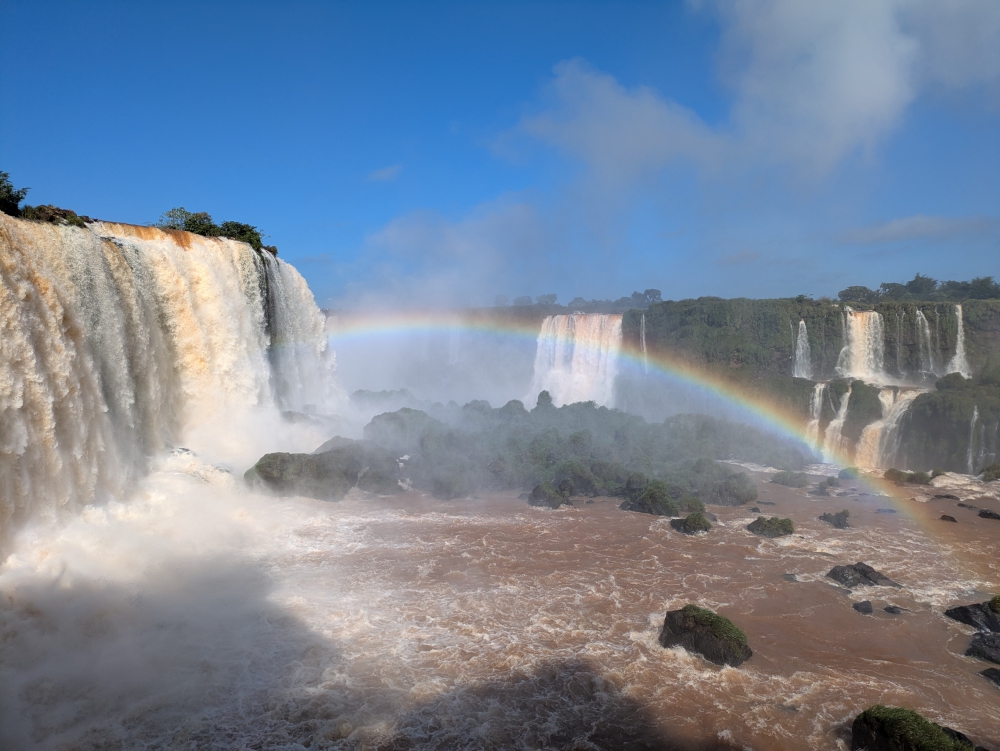
Iguaçu/Iguazú Falls are recognized as a natural wonder of the world, a UNESCO World Heritage Site, and one of the “New 7 Wonders of Nature.” The area is known for its immense scale, with 275 individual cascades spanning nearly two miles (3 km), making it the largest waterfall system in the world. The falls divide the river into the upper and lower Iguazu River and have heights of 200 to 263 feet (60–82 meters).

The amazing vista opening up after our walk – a great way to approach this site in Brazil

I had no idea that Iguaçu/Iguazu Falls straddled a border between two countries or that their name was spelled differently, depending on the side of the border. Heck, I didn’t even know just how impressive and numerous the falls were until we showed up!

Best view of the Argentinian falls

Mark and I prefer not to research highlights much or look at photos ahead of time. Just like with other spectacular sites, like Bryce Canyon and Arches National Parks in Utah, we arrived at this site “unprepared” and gazed in wonder. “Wow! Those waterfalls keep going as far as the eye can see.” Impressive! When you don’t have expectations, you can truly be surprised, awed, and inspired.

Overview of some falls at a lower level in Brazil

Iguaçu Falls in Brazil

As I mentioned in my recent expense report for June, Mark and I only planned to visit the Brazilian side of the falls, after asking among our friends which side they preferred (and why), reading comments in our free iOverlander camping app, and considering fees and logistics.

Continue reading
Older posts

© 2026 Roaming About

Theme by Anders NorenUp ↑